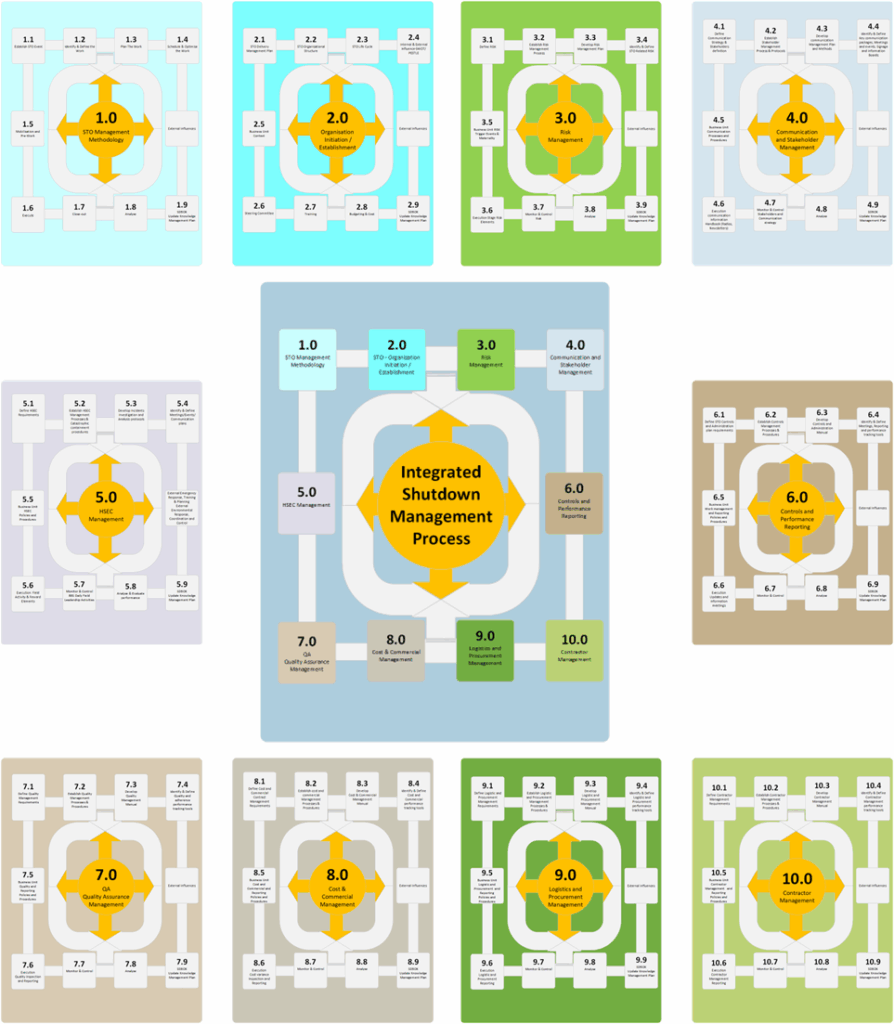
Using an Integrated Shutdown Management Model
You can use this Model, copy, distribute and share to improve shutdown practices
1.0 STO Management Methodology
Module 1.0 – STO Management Methodology
This chapter defines the structured, repeatable approach used to plan, execute, and close out shutdowns, turnarounds, and outages.
The STO Management Methodology forms the backbone of effective outage delivery. It incorporates:
- STO Gated Model (D-18 to D+1)
- Critical path controls
- Plan–Do–Check–Act (PDCA) routines
- Alignment with ISO 55001 and GFMAM frameworks
It focuses on achieving injury-free, on-time, and within-budget shutdowns by aligning people, processes, and performance metrics from start to finish.
2.0 STO Organisation Establishment
Module 2: STO Organisation Initiation / Establishment
The deliberate setup of roles, responsibilities, accountabilities, and governance structures required to deliver the shutdown event.
This phase includes:
- Appointing SPA (Single Point of Accountability)
- Defining Shutdown Steering Committee structure
- Assigning planning and workpack development leads
- Stakeholder mapping and communication hierarchy
Best Practice: Mirrors BHP and Rio Tinto steering committee governance models with risk-based ownership and RACI matrices.
3.0 RISK Management
Module 3: Risk Management
A proactive process to identify, assess, mitigate, and monitor all risks that may impact shutdown safety, schedule, cost, or performance.
- Risk Registers (strategic, operational, and workfront)
- High-risk job identification and job safety analysis (THAs, TTAs)
- Live dashboards for emergent risk
- Resilience strategies (aligned to Infrastructure Australia’s 8 resilience factors)
Key Link: Integrated into STO playbooks and 6W1H frameworks.
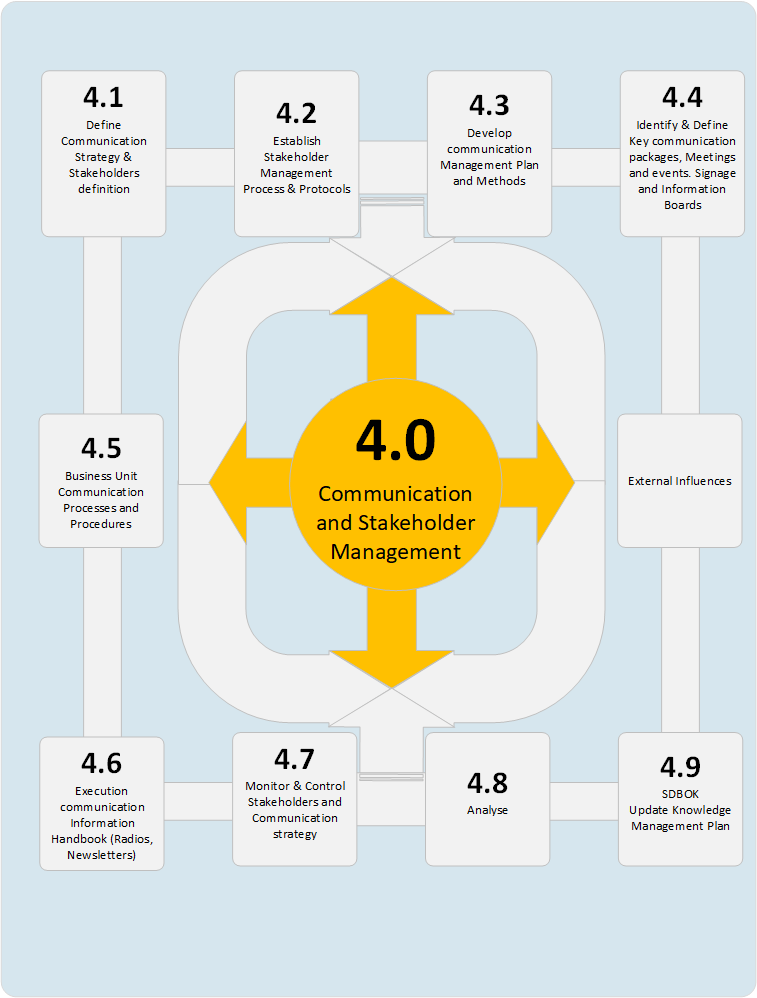
4.0 Communication and Stakeholder Management
Module 4: Communication and Stakeholder Management
The structured engagement of internal and external stakeholders to maintain alignment, transparency, and timely decision-making.
- Communication plans (daily briefings, toolbox talks, pass-ups)
- Stakeholder heat maps
- Crisis communication protocols
- Lessons learned loops and closure reporting
Best Practice Reference: Clear vertical and lateral comms channels reduce lag in decision-making and increase frontline clarity.
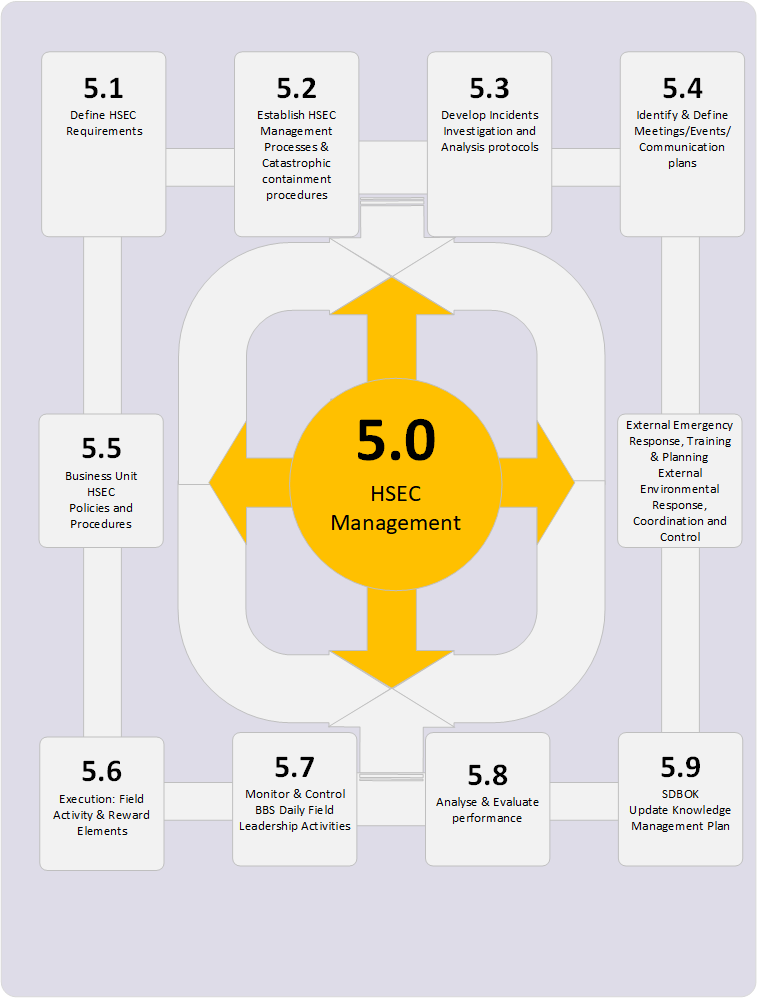
5.0 HSEC Management Process
Module 5: HSEC Management
Health, Safety, Environmental, and Community (HSEC) controls integrated into shutdown activities.
- Zero Harm safety models and incident protocols
- Safety Buddies and Field Leadership standards
- Environmental risk controls (chemical isolation, containment)
- Inclusion of local communities and cultural heritage where applicable
GFMAM Link: Strong correlation with Asset Lifecycle Stage 5 – “Maintain and Monitor”.
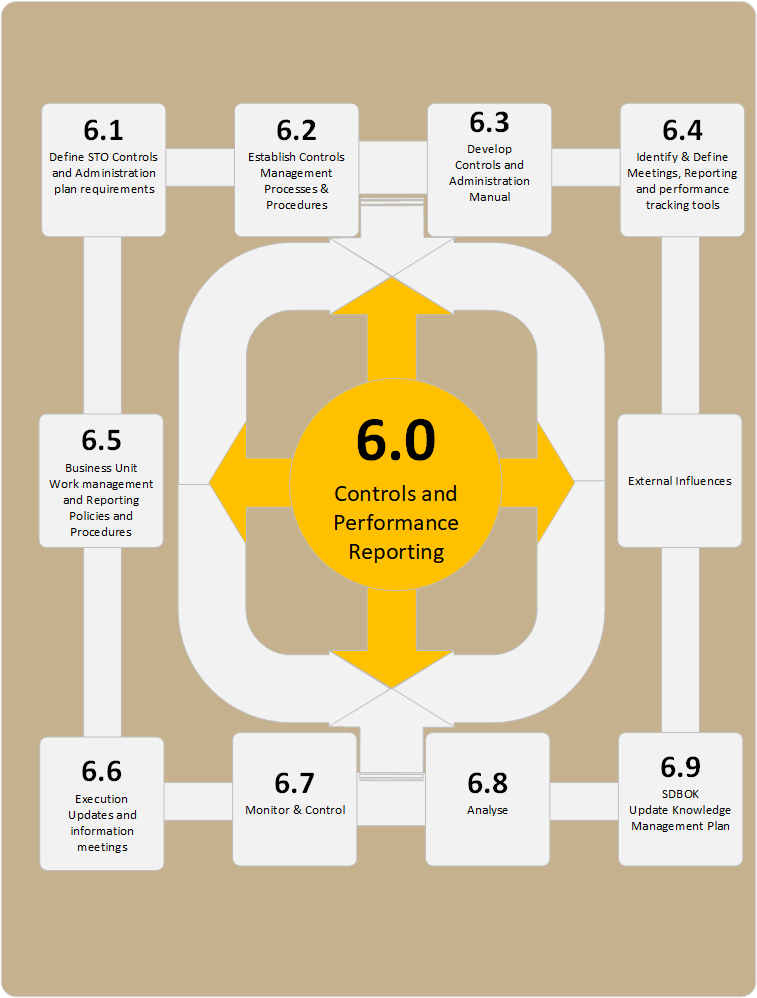
6.0 Controls and Performance Reporting
Module 6: Controls and Performance Reporting
The oversight mechanisms that monitor shutdown KPIs, cost/schedule/scope variances, and reporting against defined milestones.
- STO scorecards and dashboards
- DMS (Daily Management System)
- Performance against frozen scope, budget, permits issued
- Daily Permit vs. Execution variance reporting
Key Outcome: Enables STO leaders to act on insight, not hindsight.
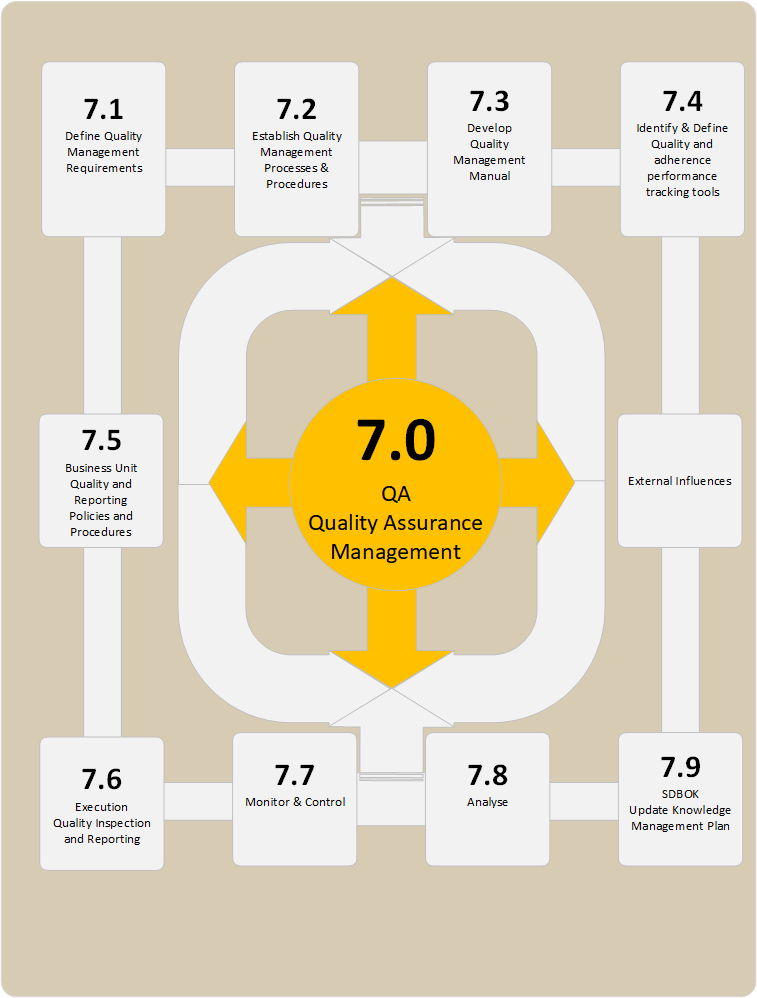
7.0 Quality Assurance Management
Module 7: Quality Assurance Management (QA/QC)
The systems and actions that ensure shutdown activities meet required technical and quality standards.
- Pre-Start QA gates and completion checklists
- NDT and testing regimes (e.g., pressure tests, alignments)
- Workpack QA procedures
- Punchlists, ITPs, and redline markups
Case Learning: Incomplete QA closure causes 40% of late restarts.
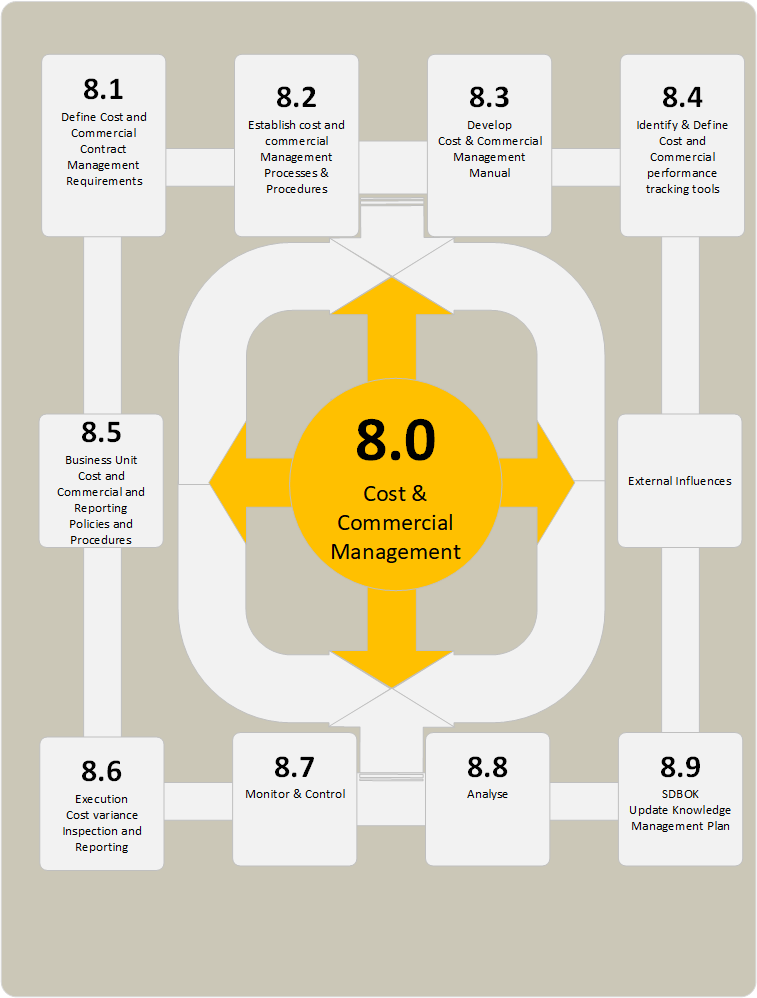
8.0 Cost & Commercial Management
Module 8: Cost and Commercial Management
The structured planning, tracking, and optimisation of financial resources related to STO delivery.
- Budget setting and spend controls
- Earned Value Management (EVM)
- Contract claim and variation management
- Commercial close-out and benchmarking
Best Practice: Tied directly to AU%, EBIT%, and recorded business benefits (>$2M in case benchmarks).
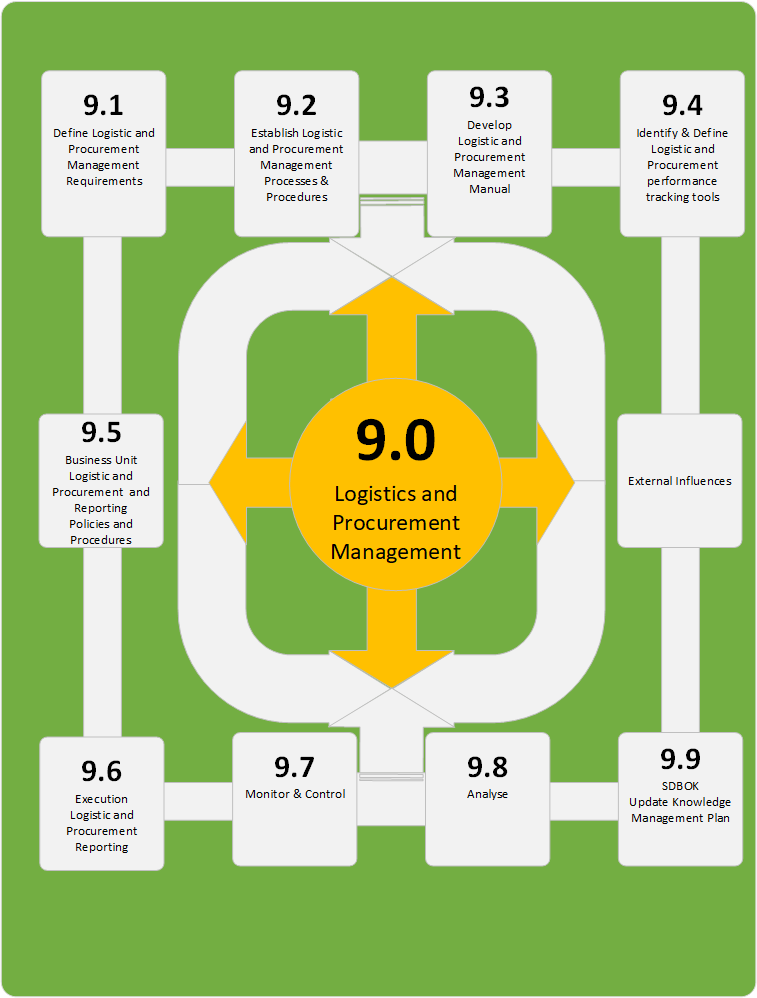
9.0 Logistics and Procurement Management
Module 9: Logistics and Procurement Management
The orchestration of materials, tools, equipment, and services to the workface on time and in full.
- Inventory visibility and turnover ratios
- Staging plans and tool stores
- Mobile equipment, transport, and cranage
- Procurement schedules, vendor readiness
Logistics Lag Risks: Emergent work and idle trades traced to poor kit and material readiness.
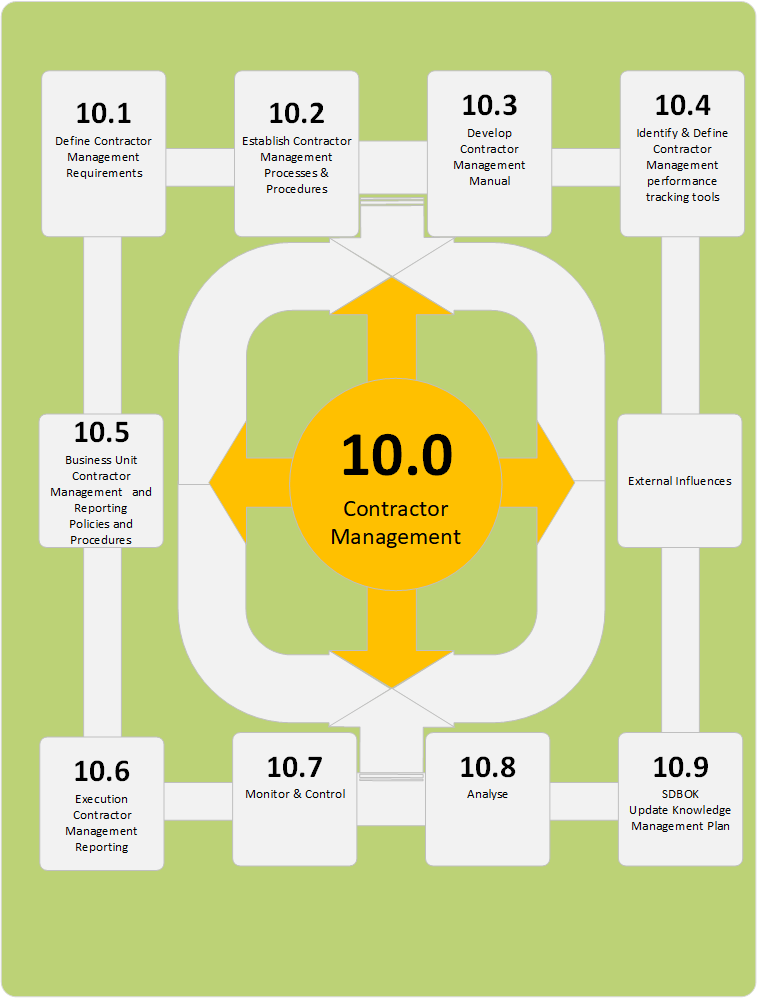
10.0 Contractor Management
Module 10: Contractor Management
Oversight and integration of third-party personnel and companies into the shutdown management system.
- Prequalification and onboarding
- Supervision ratios and fatigue management
- Contract KPIs, HSE metrics, and performance reviews
- Claim management and cultural alignment
Leadership Model Reference: Contractor visibility and mentoring critical to workface safety and efficiency.
Reflection and Notes:
Closing Note: Integration Across the STO Lifecycle
The 10 chapters reflect a modular but interconnected system where every discipline supports others. The Integrated STO Management Process relies on seamless transitions, early planning, and strong leadership.
By embedding this framework into shutdown systems, every outage can become a structured, value-adding, risk-controlled operation consistent with global benchmarks and local excellence.
STO-Shutdown, Turnaround and Outage Management Process
1.0 Integrated Shutdown Management Methodology
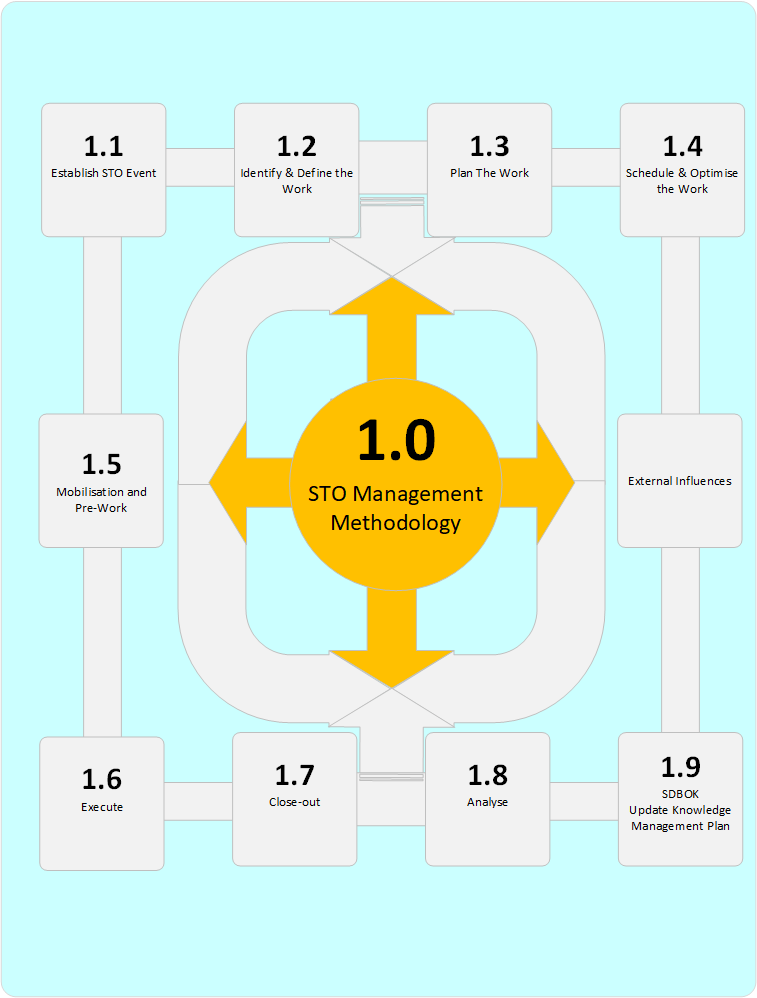
The STO Management Methodology defines the structured lifecycle and integrated processes required to plan, execute, and continuously improve Shutdowns, Turnarounds, and Outages (STOs) in asset-intensive environments. It provides the governance and guidance for decision-making, coordination, and control across all STO lifecycle phases.
This chapter forms the central node of the STO framework connecting each activity phase from initiation through close-out and post-event analysis. It ensures that STO events are managed with consistency, accountability, and strategic alignment with business objectives, reliability strategies, and asset lifecycle planning (as referenced in ISO 55001 and the GFMAM Asset Management Landscape).
The methodology comprises nine integrated elements:
1.1 Establish STO Event
1.1 Establish STO Event
Purpose: To formally initiate the STO as a business-critical project.
- Confirm trigger event (calendar, condition-based, regulatory).
- Secure executive sponsor and SPA (Single Point of Accountability).
- Define strategic intent: safety, cost, reliability uplift, compliance.
- Establish preliminary schedule and shutdown window.
- Initiate stakeholder alignment and cross-functional engagement.
Best Practice Reference: NKW Refinery and BHP Yandi adopted formal STO charters that aligned the outage with strategic priorities and capital project schedules.
1.2 Identify and Define the Work
1.2 Identify & Define the Work
Purpose: To clearly capture all shutdown scope items, aligned to risk, reliability, and compliance needs.
- Conduct scope gathering: inspections, risk registers, CMs, work orders.
- Filter and prioritise via risk-based assessment (FORC, FMECA, condition).
- Create a single consolidated STO Worklist.
- Include statutory, reliability, opportunity, and project scopes.
Benchmark Insight: Scope creep was the largest cause of unplanned delays in >40% of shutdowns reviewed. A frozen scope milestone must be enforced.
1.3 Plan the Work
1.3 Plan the Work
Purpose: To detail the activities, resources, and controls required to safely and efficiently deliver the shutdown.
- Develop workpacks and execution plans.
- Conduct risk assessments and create mitigation controls.
- Align shutdown tasks with permits, isolations, and handovers.
- Define QA/QC hold points and inspection regimes.
Integration: Links to Workpack Framework (Ref: Levitt, Singh) and 6W1H method to plan “Who, What, Where, When, With, How, Why?”
1.4 Schedule & Optimise the Work
1.4 Schedule & Optimise the Work
Purpose: To convert the plan into a logic-driven, resource-constrained, and risk-aware schedule.
- Apply CPM (Critical Path Method) and schedule logic.
- Sequence isolations, scaffold, crane, and permits.
- Perform What-If simulations and scenario testing.
- Freeze key milestones (D-6, D-3, D-1, D+1).
Case Insight: McKinsey co-designed shutdown playbooks emphasise “walk the Gantt” as a critical field validation process.
1.5 Mobilisation and Pre-Work
1.5 Mobilisation and Pre-Work
Purpose: To ensure people, tools, materials, and information are fully ready before the shutdown commences.
- Finalise contractor onboarding, training, and permits.
- Stage materials, cranes, and tools at the workface.
- Complete off-site fabrication and modular builds.
- Perform final readiness walkdowns and risk refresh.
STO Model Alignment: This phase directly links to the STO Gated Process D-8 to D-1 execution readiness.
1.6 Execute the Work
1.6 Execute
Purpose: To safely and efficiently deliver the shutdown scope in accordance with the plan and schedule.
- Initiate toolbox talks, pre-starts, and shift pass-ups.
- Track progress daily using workfront dashboards and QA checklists.
- Manage emergent work via controlled variance logs.
- Escalate and remove constraints in real-time.
Leadership Insight: Visible Field Leadership (VFL) is non-negotiable “You must be seen doing what you say.”
1.7 Close Out
1.7 Close-Out
Purpose: To hand back the plant, finalise all tasks, and formally close the STO event.
- Conduct final QA inspections, re-energisation, and commissioning.
- Execute progressive handover to operations.
- Verify compliance, documentation, and cost reconciliation.
- Finalise contractor demobilisation and site clean-up.
Best Practice Reference: “Late handover = risk multiplier.” Build in early handover triggers to reduce production ramp-up delays.
1.8 Analyse
1.8 Analyse
Purpose: To review shutdown performance and derive actionable lessons for continuous improvement.
- Conduct STO debriefs (safety, scope, cost, schedule).
- Analyse constraint logs, delay causes, and emergent work.
- Compare actual vs. planned KPIs (AU%, cost/unit, % planned complete).
- Document lessons in formal report and feed into system.
World Class Maintenance Link: This activity mirrors Lean Post-Mortems and Continuous Improvement loops.
1.9 Update Knowledge Management Plan (SDBOK)
1.9 Update Knowledge Management Plan (SDBOK)
Purpose: To capture knowledge, update standards, and enhance organisational maturity.
- Update shutdown baseline metrics.
- Revise planning templates, QA checklists, and workpacks.
- Register changes into the STO Digital Body of Knowledge (SDBOK).
- Feed insights into future STO forecasts and business cases.
Organisational Learning Reference: Hudson’s safety maturity model emphasises “Learning Culture” as the highest form of organisational performance.
External Influences
2.0 STO Organisation Establishment
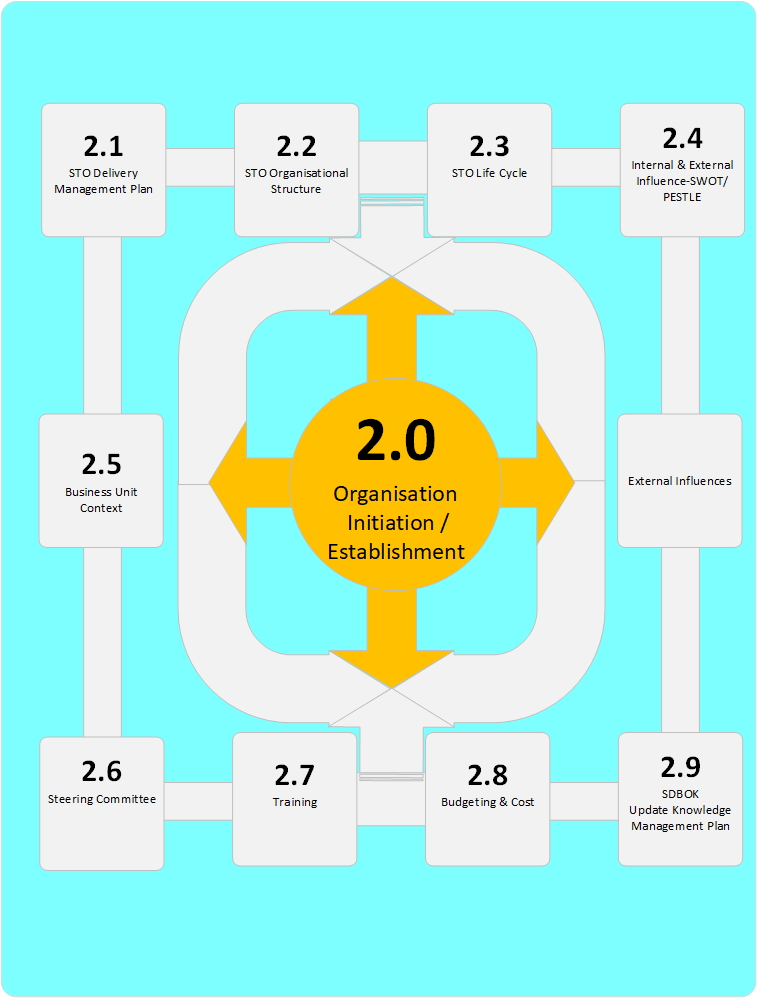
This chapter defines how a Shutdown, Turnaround, or Outage (STO) is formally initiated, structured, and integrated into the operating business. It establishes the foundation for governance, roles, responsibilities, resource allocation, and alignment to the asset management system (AMS), enabling the delivery of safe, reliable, and cost-effective events.
2.1 STO Delivery Management Plan
2.1 STO Delivery Management Plan
The STO Delivery Management Plan is the overarching document that outlines how the STO will be executed across phases. It includes scope, objectives, methodology, interfaces, and success criteria. Developed by the Shutdown Management Office (SMO) and the appointed SPA (Single Point of Accountability), it defines how planning, controls, resourcing, and assurance will be applied throughout the STO lifecycle.
Key inclusions: strategy for mobilisation, readiness, execution, and close-out, including alignment to the Strategic Asset Management Plan (SAMP).
2.2 STO Organisational Structure
2.2 STO Organisational Structure
An effective STO relies on a temporary yet functionally complete organisational model. This includes all core roles:
- Shutdown Manager (SPA)
- Planning & Workpack Team
- Safety, Quality, Logistics, and Execution Leads
- Workfront Supervisors and Coordinators
- Contract and Commercial Analysts
This structure must be documented in an organisational chart, linked to a RACI matrix to eliminate role confusion and enable rapid decisions across multiple interfaces.
Benchmark Insight: Leading sites such as NKW and Worsley defined full accountability chains using field-ready playbooks for each role.
2.3 STO Life-Cycle
2.3 STO Life Cycle
The STO lifecycle describes the logical and temporal sequencing of all phases from the business case through to final close-out and knowledge transfer. Each phase (Plan, Schedule, Mobilise, Execute, Close) includes key gates and milestone approvals.
Integration with Section 1.0: Aligns to steps 1.1 through 1.9 with supporting artefacts such as planning calendars, scope freeze dates, and early handback strategies.
2.4 Internal & External Influences
2.4 Internal & External Influence
All STOs are influenced by external and internal factors. Internally, this includes business strategies, production plans, resource availability, and plant readiness. Externally, considerations such as vendor capacity, supply chain constraints, and market pricing affect timeline, cost, and scope delivery.
A formal stakeholder impact map should be created to assess:
- Third-party dependencies
- Utilities and contractor services
- External permits, regulatory timing, or environmental controls
Best Practice: Rio Tinto incorporates an “external influence register” into early-stage readiness reviews.
2.5 Business Unit Context
2.5 Business Unit Context
To be successful, the STO must align with the strategic objectives and operational constraints of the hosting business unit. This includes:
- Production forecasts and shutdown windows
- Long-term maintenance strategies
- Capital project interfaces
- Workforce demographics and IR sensitivities
This context forms the “why” behind each STO event and should be documented in the shutdown charter.
2.6 Steering Committee
2.6 Steering Committee
The Steering Committee provides governance, oversight, and executive support. It includes cross-functional senior leaders: Maintenance, Operations, HSE, Finance, Projects, and Supply Chain. The committee meets at pre-defined intervals to:
- Review progress
- Approve risk and scope changes
- Validate shutdown readiness
- Remove strategic roadblocks
Reference to previous diagrams: The committee is central to scope optimisation, risk tolerance, and shutdown authorisation.
2.7 Training
2.7 Training
A critical but often overlooked element, training ensures that all roles understand their responsibilities and that frontline teams are competent and compliant. Training includes:
- Inductions and compliance modules
- Role-based technical upskilling
- Field Leadership and Shutdown Execution Training
- Emergency preparedness and risk response simulations
GFMAM Link: Aligns with Competency and Culture subject group “ensuring that personnel are fit-for-purpose”.
2.8 Budget & Cost
2.8 Budgeting & Cost
Accurate budgeting is essential for STO viability and credibility. Budgets are built from:
- Historical shutdown data
- Current scope estimates
- Vendor quote analysis
- Labour, tools, and material forecasts
This budget becomes the control baseline and is monitored through Earned Value Management (EVM), cost performance indices (CPI), and real-time tracking tools.
Note: Integration with Chapter 8.0 – Cost & Commercial Management is critical for this phase.
2.9 Update Knowledge Management Plan (SDBOK)
2.9 SDBOK – Update Knowledge Management Plan
The Shutdown Digital Body of Knowledge (SDBOK) must be continuously updated to capture and embed best practices, technical data, and role-specific procedures. This ensures future STOs can access templates, checklists, readiness matrices, and prior shutdown reports.
The knowledge update cycle begins even during the establishment phase by embedding structure, lessons learned, and process governance into document control and shared repositories.
External Influences
3.0 Risk Management
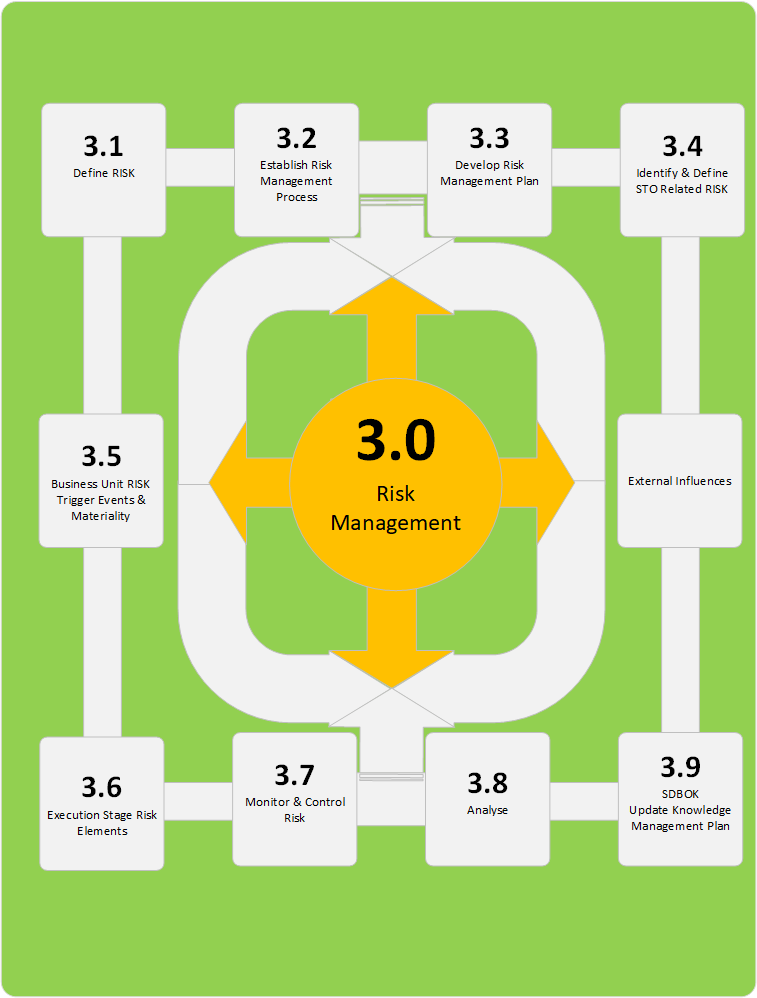
Risk management in Shutdowns, Turnarounds, and Outages (STOs) involves identifying, analysing, mitigating, and monitoring uncertainties that could impact the safe, timely, and cost-effective delivery of the event. This structured chapter ensures STO-related risks are proactively addressed across all lifecycle stages, supporting decision-making and resilience.
3.1 Define Risk
3.1 Define Risk
Risk is defined as the “effect of uncertainty on objectives” (ISO 31000). For STOs, risk may emerge from:
- Safety hazards
- Equipment failure or material delays
- Scope creep
- Resource conflicts
- Budget overruns
Both negative (threats) and positive (opportunities) risks must be considered, documented, and rated for likelihood and consequence across schedule, cost, and operational impact.
STO Note: Define risks through the lenses of People, Process, Plant, and Performance.
3.2 Establish a Risk Management Process
3.2 Establish Risk Management Process
The STO team must implement a repeatable risk management process that:
- Aligns with ISO 31000 principles
- Defines roles and responsibilities
- Establishes escalation protocols
- Includes routine reviews (daily, weekly, phase-gated)
A STO-specific risk register should be maintained within project controls systems or integrated into existing enterprise risk tools (e.g., Riskware, ARM).
Benchmark: McKinsey-implemented shutdowns included daily risk dashboards with risk heatmaps and mitigation actions for each field team.
3.3 Develop a Risk Management Plan
3.3 Develop Risk Management Plan
The Risk Management Plan must outline:
- Methodologies for risk identification and scoring (qualitative/quantitative)
- Templates for hazard logs, permit risks, and emergent events
- Risk owners and review frequency
- Contingency planning strategies and thresholds
This plan is a mandatory component of the STO Delivery Management Plan (ref. Section 2.1) and should be approved by the SPA and Steering Committee.
3.4 Identify & Define STO Related Risk
3.4 Identify & Define STO-Related Risk
STO-specific risks must be categorised across:
- Schedule: Delays due to isolation overlap, permit bottlenecks
- Logistics: Late mobilisation, equipment or tooling failure
- Safety: High-risk task interfaces, confined spaces, lifts
- Quality: QA/QC hold-point failures, rework
- Commercial: Claims, variation disputes, poor scope definition
Sources include past shutdowns, lessons learned, FMEA/RCM studies, and subject matter expert input.
Tool Reference: Use HAZOPs, bow-tie analysis, and FORC (Frequency of Occurrence × Risk Consequence) methods.
3.5 Business Unit Risk Trigger Events & Materiality
3.5 Business Unit Risk Trigger Events & Materiality
Each STO must integrate the business unit’s known risks those events that could materially affect financial, safety, or regulatory outcomes. Examples:
- Exceeding outage window with downstream production impact
- Failure to complete critical statutory inspection
- Industrial action
- External audit findings or breach
These trigger events should be flagged in advance and assigned a predefined response plan.
Good Practice: Materiality thresholds should be defined early and monitored through STO Steering Committee meetings.
3.6 Execution Stage Risk Elements
3.6 Execution Stage Risk Elements
Execution is the most dynamic and high-risk phase. Key risk elements include:
- Workfront congestion and physical clashes
- Equipment failure (cranes, scaffolds, power tools)
- Environmental exposure (heat, dust, working at heights)
- Permit coordination delays
- Safety fatigue and supervision shortfall
Risk mitigation here includes:
- Daily pre-start risk briefings
- Live risk re-assessments (JHAs/THAs updated)
- Permits and isolations coordinated in advance (e.g., via ePTW systems)
Example: Leading operations use “Shutdown Risk Boards” to highlight current and emerging execution risks by trade/zone.
3.7 Monitor and Control risk
3.7 Monitor & Control Risk
Risk must be actively tracked and updated across the STO lifecycle. Controls include:
- Live STO risk registers with RAG status
- Dashboard reporting to SPA and site leadership
- Trigger thresholds for escalation and reallocation of resources
- Integration with Daily Progress Reviews and Readiness Gate Reports
System Insight: Integrate risk controls into Primavera, MS Project, or Power BI dashboards to drive visibility.
3.8 Analyse
3.8 Analyse
Post-event analysis must investigate:
- Which risks materialised
- Effectiveness of mitigation strategies
- Whether triggers occurred without sufficient response
- Risk register completeness and maintenance
Use Root Cause Analysis (RCA), 5-Whys, or Ishikawa diagrams to categorise learnings and validate or improve risk models for future events.
GFMAM Link: Continuous Improvement – “review performance and embed learning into risk management maturity”.
3.9 Update Knowledge Management Plan (SDBOK)
3.9 SDBOK – Update Knowledge Management Plan
Risk-related lessons and artefacts must be captured and stored in the Shutdown Digital Body of Knowledge (SDBOK), including:
- Risk registers with full history logs
- Risk control plans and effectiveness reviews
- Updated checklists for critical risk types
- Visual examples (photos, incident reports)
This knowledge base ensures organisational learning and improves repeatability and maturity of risk practices over time.
Reference: ISO 31000 Clause 10 – continual improvement through internal audit and review processes.
External Influences – ISO31000
4.0 Communication and Stakeholder Management
Communication and stakeholder management is a foundational STO (Shutdown, Turnaround, Outage) discipline that ensures alignment, clarity, and collaboration across internal and external parties. It integrates strategy, tools, and behavioural expectations to maintain trust and operational readiness before, during, and after shutdown events.
4.1 Define Communication Strategy & Stakeholder Definitions
4.1 Define Communication Strategy & Stakeholders Definition
The first step is to define a structured communication strategy that answers:
- Who are the internal and external stakeholders?
- What information do they need and when?
- How will success be measured?
Stakeholders include:
- Maintenance, Operations, HSEC, Finance
- Contractors and vendors
- Executives and Steering Committees
- Community and regulatory stakeholders (where applicable)
Best Practice: Use a RASCI model to assign communication responsibilities clearly and early.
4.2 Establish Stakeholder Management Process and Protocols
4.2 Establish Stakeholder Management Process & Protocols
Stakeholder management protocols should define:
- Roles and communication hierarchy (e.g., GM → SPA → Planners/Supervisors)
- Frequency and type of updates (e.g., daily briefings, gate reviews)
- Confidentiality rules and escalation paths
- Preferred channels (verbal, email, SharePoint, radios, newsletter)
Reference: GFMAM Subject Group 5 – “Asset Decision-Making” emphasizes integrated stakeholder views.
4.3 Develop Communication Management Plan and Methods
4.3 Develop Communication Management Plan and Methods
This plan serves as a blueprint for the entire shutdown lifecycle and should include:
- Stakeholder register with mapped expectations
- Communication types (Push, Pull, Interactive)
- Meeting cadences (e.g., weekly readiness reviews, daily toolbox)
- Tools (Power BI dashboards, radios, signage, bulletin boards)
Field Insight: Best-in-class sites deploy both visual (e.g., wall planners, scoreboards) and digital (e.g., mobile alerts) tools.
4.4 Identify & Define Key Communication Channels
4.4 Identify & Define Key Communication Packages, Meetings, and Events
Standard shutdown communication elements must be mapped in advance:
- Project Kick-off and Pre-shutdown briefings
- Daily Execution Meetings and Contractor Stand-ups
- Weekly Lookaheads and Leadership Reviews
- Lessons Learned and Close-out Reviews
Key tools include:
- Visual controls: Gantt charts, visual KPIs, signage
- Digital alerts: Safety alerts, change bulletins
- Shared drives for central access
Pro Tip: Include visual management boards at gate access points and crib rooms.
4.5 Business Unit Communication Processes and Procedures
4.5 Business Unit Communication Processes and Procedures
Shutdown communication should integrate with existing BU systems, including:
- Enterprise communication protocols (e.g., SharePoint updates)
- Permit & risk communication (PTW, THAs, emergency plans)
- Process mapping for approvals and sign-offs
Reference: ISO 55001 Clause 7.4 Communication – internal and external information flow must be consistent, managed, and accessible.
4.6 Execution Communication Information Handbook
4.6 Execution Communication: Radios, Newsletters, Handbooks
During execution, communication must be real-time, clear, and direct:
- Radios assigned with channel discipline
- Emergency response protocols and contact lists
- Printed newsletters and crib room posters
- Flash safety bulletins for incident learning
Execution Tip: Implement “T-card” systems and logbooks for shift handovers.
4.7 Monitor and Control Stakeholder Communication Strategy
4.7 Monitor & Control Stakeholders and Communication Strategy
Communications should be continuously monitored:
- Are communications reaching the right people on time?
- Are risks, changes, or decisions clearly understood?
Methods include:
- Stakeholder feedback forms
- Toolbox meeting effectiveness audits
- Communication effectiveness KPIs (e.g., issue resolution time, miscommunication rate)
Use: Pulse check surveys during peak execution for real-time adjustment.
4.8 Analyse
4.8 Analyse
Post-shutdown, analyse:
- What channels worked well?
- Were any stakeholders misaligned or missed?
- What communication errors led to safety or scheduling incidents?
Insights should be documented using:
- RCA (Root Cause Analysis) of breakdowns
- Surveys of frontline and contractor feedback
- Communication flow diagrams
4.9 Update Knowledge Management Plan (SDBOK)
4.9 SDBOK – Update Knowledge Management Plan
All learnings and artefacts related to communication should be captured in the Shutdown Digital Body of Knowledge (SDBOK):
- Playbooks for stakeholder management
- Meeting templates and cadences
- Crisis communication logs
- Updated stakeholder maps and preferences
Maintenance Model Integration: Align updates with ISO 55001 management review and improvement clauses.
External Influences – PESTLE
5.0 HSEC Management (Health, Safety, Environment and Community)
HSEC Management in the STO environment refers to the systematic integration of Health, Safety, Environmental, and Community controls within the shutdown lifecycle. It aims to eliminate harm, prevent environmental impacts, and strengthen visible leadership in safety performance before, during, and after the shutdown event.
5.1 Define HSEC Requirements
5.1 Define HSSE Requirements
Shutdowns require clearly articulated Health, Safety, Security, and Environmental (HSSE) requirements that align with:
- Corporate and site policies
- Regulatory and legislative standards (e.g., WHS Act, EPA, ISO 14001)
- Shutdown-specific risks (e.g., confined space, simultaneous operations)
These are defined early during the planning phase and documented in the Shutdown HSSE Management Plan.
Best Practice Reference: ISO 45001:2018 Clause 6.1 – hazard identification and planning actions to address risks and opportunities.
5.2 Establish HSEC Management Processes and Catastrophic Containment Procedures
5.2 Establish H&S Management Processes & Catastrophic Containment Procedures
All high-risk shutdown activities require safety-critical controls, including:
- Permit-to-work systems
- Energy isolation (LOTO)
- Emergency response plans (fires, spills, fatalities)
- Confined space and working at heights protocols
- Environmental containment plans (stormwater, chemical exposure, air quality)
Processes must be embedded in site induction and reinforced daily during the shutdown.
Benchmark: Anglo American shutdowns mandate catastrophic risk containment drills and critical control verification pre-start.
5.3 Develop Incident Investigation and Analysis Protocols
5.3 Develop Incident Investigation and Analysis Protocols
Incident investigation readiness includes:
- Templates and toolkits for ICAM or TapRoot methods
- Clear classification of injuries and events (e.g., FAC, MTI, LTI, HPI)
- Triggers for shutdown pause and escalation
- Roles for site managers, HSEC leads, and external advisors
Each shutdown should pre-assign lead investigators and escalation matrices.
Case Example: At Kwinana Nickel Refinery, a field coaching protocol was used for daily observations feeding into the TRI reduction strategy.
5.4 Identify & Define HSEC Meeting and Communication Plans
5.4 Identify & Define Meetings/Events/Communication Plans
A defined rhythm of HSEC-related communication ensures awareness and behavioural alignment:
- HSEC start-up safety share
- Daily permit reviews
- Safety stand-down meetings for breaches
- Contractor safety moments and recognitions
- Community updates (noise, access, traffic)
These engagements form part of the Visible Felt Leadership (VFL) strategy.
5.5 Business Unit HSEC Policies and Procedures
5.5 Business Unit HSSE Policies and Procedures
The STO must not override site HSSE protocols instead, it must integrate:
- Site HSEC charters
- Risk registers and bowtie assessments
- Material safety data sheets (MSDS)
- Waste management and environmental compliance systems
Integration Insight: Use the “One Page Safety Plan” approach to cascade site policies into daily team briefings.
5.6 Execution : Field Activity & Reward Elements
5.6 Execution Field Activity & Reward Elements
During execution:
- Field observations (TTT, BBS cards) are captured and actioned daily
- Rewards are aligned to behavioural safety performance not compliance
- Toolbox talks reflect live risks and lessons
- Leaders are measured on % time spent in field (minimum 2 hours/day)
Field Benchmark: Rio Tinto iron ore division used a tiered recognition matrix for safety interventions (e.g., gold/silver/bronze).
5.7 Monitor and Control BBS Daily Field Leadership Activities
5.7 Monitor & Control BBS Daily Field Leadership Activities
Behaviour-Based Safety (BBS) systems must track:
- Daily interactions (Who, Where, What was seen, What was corrected)
- Feedback loops into leadership meetings
- Visual dashboards showing open vs closed observations
Audits and spot checks by superintendents validate the engagement quality.
Framework Alignment: GFMAM Landscape Subject Group 7 – Asset Risk Management requires proactive hazard identification and resolution tracking.
5.8 Analyse
5.8 Analyse & Evaluate Performance
HSEC KPIs must be reviewed weekly:
- Total Recordable Injury Frequency Rate (TRIFR)
- Near miss and hazard reporting trends
- Environmental deviations (e.g., waste, water, emissions)
- Critical control integrity (verified vs implemented)
After the shutdown, a formal HSEC performance review is required to support continuous improvement.
Tools: Power BI dashboards, heatmaps, and lead/lag indicators.
5.9 Update Knowledge Management Plan (SDBOK)
5.9 SDBOK – Update Knowledge Management Plan
Learnings, tools, and templates must be integrated into the Shutdown Digital Body of Knowledge (SDBOK), including:
- Incident reports
- Updated procedures (e.g., revised THA format)
- Videos or simulations of field learning
Case studies for future planning reference
External Influences – ERT – Emergency Response Teams
6.0 Controls and Performance Reporting
Controls and Performance Reporting is the governance layer of a shutdown. It ensures visibility of shutdown progress, financial accountability, resource tracking, and variance management. This domain connects field execution to strategic insight and informs leadership decisions through structured data and consistent control mechanisms.
6.1 Define STO Controls and Administration Plan Requirements
6.1 Define STO Controls and Administration Plan Requirements
A comprehensive Shutdown Controls and Administration Plan outlines:
- Governance structure for cost, schedule, and risk reporting
- Delegation of authority and approval workflows
- Required reporting frequency and formats (daily, weekly, shift-based)
- Integration points with enterprise systems (e.g., SAP, 1SAP, Maximo)
- Definition of ‘control points’ across planning, execution, and close-out
Best Practice Reference: BHP and Shell standardize control documents within the STO Event Governance Model to enable consistency across business units.
6.2 Establish Controls Management Processes and Procedures
6.2 Establish Controls Management Processes & Procedures
Establishing control processes includes:
- Change control protocols (scope, cost, schedule)
- Documented reporting templates (Shift Log, Look-Ahead, Earned Value)
- Cost control procedures including commitment registers and accruals
- Progress measurement logic (WBS, % complete, P6/Gantt integration)
- Setup of document control registers for traceability
These are formalised prior to execution, reviewed in gate approvals, and audited post-event.
6.3 Develop Controls and Administration Manual
6.3 Develop Controls and Administration Manual
The Controls Manual forms the blueprint for all shutdown data handling. It includes:
- Shutdown Cost Control Framework
- Resource tracking methodologies (labour, equipment, materials)
- KPI alignment to budget (AU%, OEE loss recovery, asset availability)
- Schedule control logic and deviation thresholds
- Contract performance dashboards
The manual is shared with planners, cost engineers, finance, and package owners to ensure aligned execution.
Benchmark: Rio Tinto’s use of performance staging documents enables mid-execution forecasts and trend analysis.
6.4 Identify & Define Reporting and Performance Tracking Plans
6.4 Identify & Define Meetings, Reporting & Performance Tracking Tools
Define a clear reporting rhythm such as:
- Daily Shift Handover Reviews
- Weekly Leadership Reports
- Contractor Weekly Progress Reviews
- Variance Reports (Earned vs Planned)
- Executive Flash Reports
Tools may include:
- Primavera P6 / MS Project
- SAP/1SAP or equivalent ERP
- Power BI dashboards
- RAID Logs
- Visual Management Boards in war rooms
6.5 Business Unit Work Management and Reporting Policies and Procedures
6.5 Business Unit Work Management & Reporting Policies and Procedures
Business units often have specific control and reporting expectations. These must be embedded into the shutdown environment:
- Work order hierarchy and WBS alignment
- Cost codes and GL segmentation
- Alignment with site reporting cycles and finance calendar
- Harmonisation of shutdown reporting into Business Operating Systems (BOS)
Case Reference: Kwinana Nickel Refinery integrated shutdown schedule adherence tracking into their DMS system to align with monthly KPI scorecards.
6.6 Execution: Update and Information Meetings
6.6 Execution Update and Information Meetings
In the field, execution updates must be timely, visual, and action-oriented:
- Daily morning stand-ups with key trades, supervision, and package owners
- Field escalation meetings (critical path blockers)
- Daily emerging work reviews and scope adjustments
- “End of Shift” report alignment
Visual boards are used to show:
- Completed vs remaining work
- Safety performance
- Schedule slippage and recovery plans
6.7 Monitor and Control
6.7 Monitor & Control
Monitoring mechanisms must actively track:
- Performance to Plan: Quantity installed vs Planned
- Labour productivity: AU%, fatigue management, site presence
- Emergent scope: Unplanned jobs, hours, cost
- Contractor KPIs: Compliance to deliverables, safety, mobilisation adherence
- Financial performance: Variance to budget, committed vs actual
Tools: Heatmaps, Control Charts, KPI Dashboards, Weekly Stoplight Reports
6.8 Analyse
6.8 Analyse
Performance analysis post-event supports:
- Trend reviews across historical shutdowns
- Root cause identification of over/underperformance
- Key learning extraction for improvement
- Statistical modelling for future estimation (labour hours, MTTR, spares consumption)
Analyses feed directly into post-mortem sessions and governance reviews.
6.9 Update Knowledge Management Plan (SDBOK)
6.9 SDBOK – Update Knowledge Management Plan
Post-event, the control team must contribute to the Shutdown Digital Body of Knowledge (SDBOK) by uploading:
- Control logs
- Trend data
- Lessons learned
- Cost forecasting accuracy
- Actual vs Planned benchmarking curves
This closes the knowledge loop and creates readiness for future STOs.
External Influences – External Information Management Tools
7.0 Quality Assurance Management
Quality Assurance (QA) Management is a cornerstone of shutdown success, ensuring that all work is executed to agreed standards, specifications, and expectations. It drives reliability, compliance, and asset integrity by embedding quality into every stage from planning to execution and close-out. QA during shutdowns is not just about detecting defects it’s about preventing them.
7.1 Define Quality Management Requirements
7.1 Define Quality Management Requirements
Define shutdown-specific QA expectations, including:
- Conformance to engineering drawings, OEM specifications, and legislative codes
- Site-specific QA governance models and approval processes
- Regulatory standards such as ISO 9001, AS/NZS 5131, or client-specific benchmarks
- Identification of Critical Quality Attributes (CQA) across trades
Key outputs:
- Shutdown QA Plan
- Acceptance criteria for critical packages
- Defined QA hold and witness points
7.2 Establish Quality Management Processes and Procedures
7.2 Establish Quality Management Processes & Procedures
This involves setting up end-to-end processes for:
- QA documentation control (ITP, MDRs, QA forms)
- Material traceability and certification workflows
- Inspection & Test Plan (ITP) development and approval
- Quality Walkdowns and Closeout Checklists
- NCR and Corrective Action workflow
Best practice reference: Worsley Alumina mandates ITP checklists embedded in workpacks and enforced through planner QA signoff gates.
7.3 Develop Quality Management Manual
7.3 Develop Quality Management Manual
The QA Manual must include:
- Project-specific QA philosophy
- Roles and responsibilities (QA Inspector, Supervisor, Certifying Engineer)
- Reference documents (specs, standards, drawings)
- Audit schedules and compliance documentation
- RACI matrix for quality hold/review points
This manual is typically developed pre-Gate 3 and approved by the Asset Integrity and Engineering Authority.
7.4 Identify & Define QA Reporting and Adherence Tracking Plans
7.4 Identify & Define Quality and Adherence Performance Tracking Tools
Key tools include:
- Quality Dashboards (live ITP completion rates, NCR logs)
- QA Checklists by trade discipline
- Turnover Package Tracking (mechanical completion, punch lists)
- QA metrics (e.g., weld reject rates, torque audit pass rates)
- Field inspection apps (Fulcrum, GoCanvas)
Integration Tip: Link quality tracking to Primavera or MS Project milestones for real-time visibility.
7.5 Business Unit QA Reporting Policies and Procedures
7.5 Business Unit Quality and Reporting Policies and Procedures
Business Units must align QA with enterprise-wide quality assurance policies:
- Interface with Asset Management System (ISO 55001)
- Tagging and Certification requirements
- Pressure equipment and hazardous area compliance (e.g. EEHA)
- QA standards for brownfield integration and CAPEX scope
Reference: BHP Nickel West uses a multi-level document control system aligned to WPCG and internal QA codes.
7.6 Execution: Quality Inspection and Reporting
7.6 Execution Quality Inspection and Reporting
During field execution:
- Implement shift-based QA checks and checklists
- Maintain rolling NCR logs with close-out validation
- Perform dimensional checks, material conformity audits, and torque checks
- Conduct joint walkdowns before release to Operations
Field QA reports must be traceable, auditable, and uploaded to the site’s DMS (Document Management System).
7.7 Monitor and Control
7.7 Monitor & Control
Actively control quality through:
- ITP completion audits (% by work package)
- Cross-discipline QA spot audits
- Progressive QA milestone validation before handover
- Real-time alerting of any QA non-conformances
Use leading indicators like QA punch volume, rework ratios, and hold point breaches.
7.8 Analyse
7.9 Update Knowledge Management Plan (SDBOK)
External Influences – ISO 9001
8.0 Cost and Commercial Management
Cost and Commercial Management ensures that shutdowns are executed within financial constraints, aligned with contract obligations, and provide value-for-money outcomes. It integrates budget governance, contractor performance, commercial risk mitigation, and real-time cost reporting.
In shutdowns, effective cost and commercial control is not just about tracking spend it’s about enabling proactive decisions to optimise outcomes before money is committed.
8.1 Define Cost and Commercial Contract Management Requirements
8.1 Define Cost and Commercial Contract Management Requirements
Clearly define:
- Scope of contracts (lump sum, schedule of rates, time & materials)
- Financial approval thresholds
- Cost centres and WBS structures
- Compliance with company procurement, finance and legal policies
- Claims management process and escalation pathways
Output: Defined commercial baseline including contract types, POs, variations, and compensation events.
8.2 Establish Cost and Commercial Management Processes and Procedures
8.2 Establish Cost & Commercial Management Processes & Procedures
Develop procedures covering:
- Contractor onboarding and T&Cs
- PO requisition, approval and tracking
- Variation and claims management (VO, CO, EOT)
- Labour and equipment rate control
- Reporting frequency and template structures
Include delegation of authority (DoA) and approval workflows to ensure financial discipline.
8.3 Develop Cost and Commercial Management Manual
8.3 Develop Cost & Commercial Management Manual
The manual should document:
- Project controls framework
- WBS and CBS alignment
- Performance reporting formats (Earned Value, CPI, SPI)
- Standardised variation request forms
- Internal audit readiness protocols
Reference: McKinsey shutdown playbooks recommend pairing commercial tracking with daily visual boards during execution.
8.4 Identify & Define Cost and Commercial Performance Tracking Tools
8.4 Identify & Define Cost and Commercial Performance Tracking Tools
Establish toolsets for:
- Cost phasing dashboards
- Burn-up charts (budget vs. actual)
- Commitments ledger and accrual tracking
- Forecasting models (Estimate to Complete / Estimate at Completion)
- Procurement and vendor milestone payments
- Claims and variations tracking system
Integrate SAP, PRISM, Power BI, and Excel-based trackers for various levels of user maturity.
8.5 Business Unit Cost and Commercial Reporting Policies and Procedures
8.5 Business Unit Cost and Commercial Reporting Policies and Procedures
Business unit policies must:
- Align with corporate finance systems and capex/opex rules
- Define journal management, accrual cycles, and fixed asset treatment
- Support budget uplift requests through defined change processes
- Reinforce monthly forecasting and reconciliation accountability
Tip: Use cost codes that match SAP hierarchies to reduce reconciliation delays.
8.6 Execution: Cost Variation and Reporting
8.6 Execution Cost Variance Inspection and Reporting
During execution:
- Daily/weekly reporting of cost performance
- Track labour hours, consumables, equipment hire, and materials usage
- Variation validation vs original scope
- Contractor performance vs. quoted cost/time baseline
Variance categories: scope growth, productivity deviation, emergent conditions, and contractual delays.
8.7 Monitor and Control
8.7 Monitor & Control
Proactively control costs through:
- Cost containment KPIs (e.g. CPI > 0.9)
- Commercial performance reviews
- Hold-point release contingent on value-for-money evidence
- Stage-gate commercial approvals linked to shutdown milestones
Insight: “Commercial discipline is what prevents financial blowouts masked by operational complexity.”
8.8 Analyse
8.8 Analyse
Post-event analysis includes:
- Budget vs. actual breakdowns (by WBS, vendor, discipline)
- Variation claims root cause
- ROI analysis (based on risk-cost-performance)
- Cost per unit output for benchmarking across outages
Outcome: Commercial lessons learned entered into shutdown benchmarking library.
8.9 Update Knowledge Management Plan (SDBOK)
8.9 SDBOK – Update Knowledge Management Plan
Capture and share:
- Updated vendor performance metrics
- Commercial risk registers and mitigation plans
- Template packs for future contracts
- Lessons from contract administration, claims, and audits
SDBOK entries support continuous improvement and onboarding for future shutdown planners and cost engineers.
External Influences – GFMAM – IPWEA, IIMM
9.0 Logistics and Procurement Management
Logistics and Procurement Management ensures the right people, materials, tools, and services arrive in the right place, in the right condition, at the right time, and at the right cost. In shutdown execution, where delays cost millions, logistics and procurement effectiveness is the difference between planned outcomes and systemic failure. This chapter provides the strategic, procedural, and operational guidelines for shutdown logistics and procurement, referencing best practices from major iron ore, aluminium, and petroleum operations globally.
9.1 Define Logistics & Procurement Contract Management Requirements
9.1 Define Logistics and Procurement Management Requirements
Establish the total requirements across:
- Labour transport, flights, buses, accommodation
- Tool and equipment mobilisation
- Material ordering and staging
- Induction scheduling
- Supply base coordination
- Warehouse and laydown management
- Critical spare delivery lead-times
Key Principle: Early alignment with shutdown scope and work packs is essential to avoid duplication, delays, and logistics overload.
9.2 Establish Logistics & Procurement Management Processes and Procedures
9.2 Establish Logistics and Procurement Management Processes & Procedures
Develop standard operating procedures (SOPs) covering:
- Material Requests (MR) and Purchase Requisitions (PR)
- Contractor mobilisation and demobilisation protocols
- Pre-start mobilisation reviews and checklists
- Site access, equipment tracking, and laydown yard assignment
- Consumables control and daily inventory reporting
Include: Permit-to-logistics (PTL) workflows, staging matrix templates, and transport rosters.
9.3 Develop Logistics & Procurement Management Manual
9.3 Develop Logistics and Procurement Management Manual
Document includes:
- Mobilisation checklist (flights, inductions, PPE, VOCs)
- Staging area layout and labelling schema
- OSR (Off Site Repair) process flows
- Packing requirements and Dangerous Goods (DG) compliance
- Procurement timelines aligned to the 14-week shutdown planning cycle
Reference case studies from Worsley and Mozal demonstrate the value of a pre-approved logistics readiness manual distributed to all shutdown contractors.
9.4 Identify & Define Logistics & Procurement Performance Tracking Tools
9.4 Identify & Define Logistics and Procurement Performance Tracking Tools
Establish systems to track:
- PR to PO turnaround times
- Delivery in Full on Time (DIFOT) rates
- Accommodation occupancy rates and FIFO schedules
- Tool store check-in/check-out status
- Transport wait times and bottlenecks
- Daily material staging % completion
Tools: SAP MM, Power BI logistics dashboards, QR-tagged inventory tracking, and contractor mobilisation dashboards.
9.5 Business Unit Logistics & Procurement Reporting Policies and Procedures
9.5 Business Unit Logistics and Procurement Reporting Policies and Procedures
Align reporting structures with:
- Daily resource movement reports
- Material delays escalation protocols
- Weekly logistics performance summaries
- FIFO logistics dashboards to the business unit level
- 3-month look-ahead vs. 1-week execution review
Reports should be shared with operations, finance, shutdown execution, and safety weekly.
9.6 Execution: Logistics & Procurement Reporting
9.6 Execution Logistics and Procurement Reporting
During execution, track:
- Material non-conformance (MNC) incidents
- Tool availability against workpack requirements
- Lost time due to equipment delay or no-shows
- Consumable depletion rates vs. forecast
- Crib-room, crib-locker and site accessibility issues
Consider dynamic heatmaps of material readiness and staging compliance for shift supervisors.
9.7 Monitor and Control
9.7 Monitor & Control
Apply operational control using:
- Readiness gates: materials in place before job card release
- Milestone tracking for equipment delivery and crew mobilisation
- Integration of site access/VOC/induction/transport on single dashboard
- Exception-based reporting: red-flag any stockouts, backlog transport
Benchmark: Rio Tinto’s T&I logistics team integrated SAP and Maximo to flag all red zones >24 hours from due date.
9.8 Analyse
9.8 Analyse
Post-outage analytics must cover:
- Mobilisation cost vs. forecast
- Lead time variance analysis
- Laydown area effectiveness and bottlenecks
- Material surplus/shortfall impacts
- Return-to-store value tracking
- OSR turnaround and cost recovery evaluation
Deliver insights into root causes for logistics delays and materials waste.
9.9 Update Knowledge Management Plan (SDBOK)
9.9 SDBOK – Update Knowledge Management Plan
Capture and update:
- Logistics plans and tools used during shutdown
- Lessons learned from mobilisation/demobilisation
- Procurement performance by vendor and material class
- Optimised standard packlists and warehouse layout plans
- Updated templates: MR, PR, VOC registers, staging logs
SDBOK Contribution: Build a playbook of vendor readiness, transport scheduling, and tool store operations for future events.
External Influences – GFMAM – IPWEA, IIMM
10.0 Contractor Management
Contractor Management is a critical component of Shutdown, Turnaround, and Outage (STO) delivery. It ensures third-party service providers are selected, inducted, mobilised, monitored, and demobilised in a manner that aligns with safety, quality, cost, and schedule objectives. This chapter outlines a comprehensive framework for managing contractors across the full STO lifecycle, ensuring high-performance, compliance, and safe work execution across all external workforce interfaces.
10.1 Define Contractor Management Requirements
10.1 Define Contractor Management Requirements
Define the core expectations and compliance boundaries for:
- Scope-specific contractor engagement
- Pre-qualification and capability assessment
- HSE, HR, IR and training prerequisites
- Contractual deliverables and mobilisation guidelines
- Commercial terms and risk allocation
Best Practice Tip: Establish a Contractor Management Framework aligned with ISO 45001, ISO 9001, and the GFMAM Maintenance Management Framework.
10.2 Establish Contractor Management Processes and Procedures
10.2 Establish Contractor Management Processes & Procedures
Establish repeatable processes for:
- Tendering and vendor evaluation
- Award and mobilisation protocols
- Site entry criteria, including drug and alcohol testing
- Daily toolbox meetings and field presence
- Performance management and contract exit procedures
Procedure Pack: Include Contractor Onboarding Checklist, Site Access Matrix, and IR resolution workflow.
10.3 Develop Contractor Management Manual
10.3 Develop Contractor Management Manual
The manual should include:
- Governance structure for contractor supervision
- Induction and competency assurance
- Scope and cost tracking templates
- Daily attendance and compliance verification
- Chain of command for execution issues
Case Example: In WA iron ore operations, shutdowns were successfully delivered using contractor governance playbooks with embedded lead indicators and escalation protocols.
10.4 Identify & Define Contractor Performance Tracking Tools
10.4 Identify & Define Contractor Management Performance Tracking Tools
Track and report using:
- Site attendance verification (turnstile + digital logs)
- Induction completion and skill validation
- Workpack progress and productivity metrics
- Compliance with TTT/THA and BBS leadership activities
- IR issues, disputes, and resolutions
Digital Tools: Use Power BI dashboards to link workpack closeout with contractor accountability.
10.5 Business Unit Contractor Reporting Policies and Procedures
10.5 Business Unit Contractor Management and Reporting Policies and Procedures
Ensure alignment through:
- Daily Contractor Performance Reviews (CPR)
- Use of Site Standard KPI scorecards
- Documented feedback loops to procurement teams
- Integration of safety, quality, and cost performance into a unified dashboard
Governance Tip: Align internal reporting with contract milestones and invoice approval workflows.
10.6 Execution: Contractor Reporting
10.6 Execution Contractor Management Reporting
During execution, enforce:
- Daily execution dashboards (resources vs. productivity)
- “On Time / Ready for Work” (OTRW) tracking
- Field leadership visibility with contractor crews
- Immediate escalation of non-compliance
- Daily sign-offs and forward look meetings
Metric: Labour availability vs. earned hours curve is a key indicator of contractor performance.
10.7 Monitor and Control
10.7 Monitor & Control
Control elements include:
- Field audits for compliance against safety and quality standards
- Formal variance reports (scope, cost, schedule)
- Intervention protocols for poor behaviour, rework, or absenteeism
- Authority-to-Stop clauses embedded in contracts
Control Loop: Use Plan-Do-Check-Act (PDCA) cycle embedded in site shutdown protocols.
10.8 Analyse
10.8 Analyse
Post-event reviews should analyse:
- Overall contractor performance scorecard
- Workforce attrition, safety statistics, and productivity
- Effectiveness of mobilisation/demobilisation
- Leading vs. lagging indicators of success/failure
- Root causes of contractor underperformance
Analytic Tip: Benchmark contractors across shutdowns to prioritise future engagement.
10.9 Update Knowledge Management Plan (SDBOK)
10.9 SDBOK – Update Knowledge Management Plan
Ensure all contractor-related lessons learned are captured:
- Scope of work misalignments
- Field performance variance explanations
- Onboarding friction points
- Safety, quality, or IR deviations
- Commercial risk issues and dispute resolutions
SDBOK Input: Update master templates for contractor induction packs, vendor scorecards, and future work scopes.