The Asset Academy Reference Portal
Standards and Reference Guide for Asset-Intensive Organisations
This portal converts the standards reference map into a practical web guide that users can navigate by theme. It is structured to help leaders, engineers, maintainers, planners, reliability teams, and asset managers understand which standards, frameworks, and industry references support an effective asset management system.
The intent is to provide a structured pathway so a user can quickly identify the purpose of each reference, where it fits, and what part of the asset management landscape it informs.
Reference Map
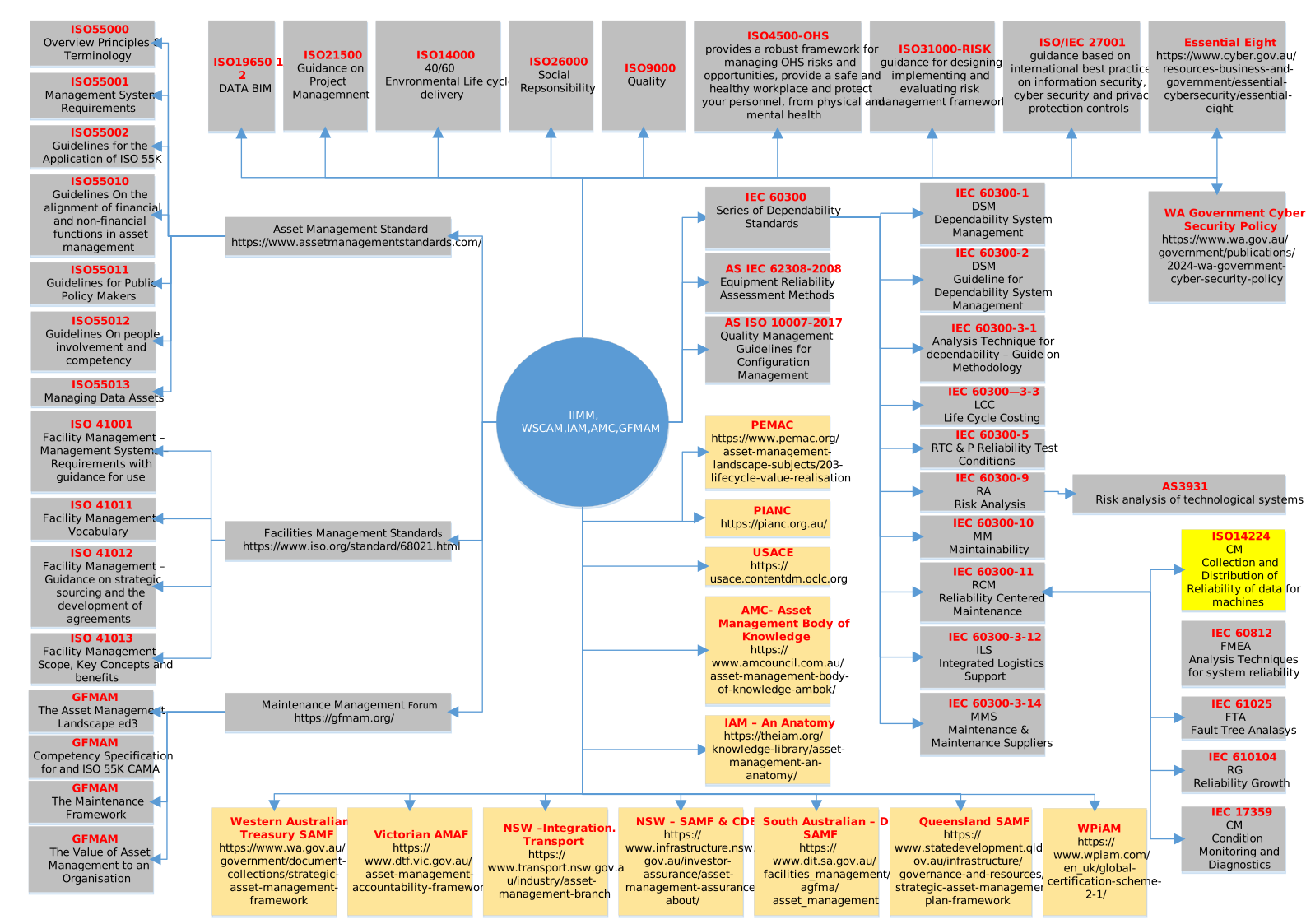 Open SVG reference map
Select the image or the button below to open the full SVG version of the original standards map.
Open SVG reference map
1. Core Asset Management Standards
−
ISO 55000
Overview, Principles and Terminology
Defines the fundamentals of asset management and the common language used across the discipline. This is the logical start point for understanding purpose, value, alignment, and system vocabulary.
ISO 55001
Management System Requirements
Specifies the requirements for establishing, implementing, maintaining, and improving an asset management system. It is the principal certifiable reference for asset-intensive organisations.
ISO 55002
Guidelines for the Application of ISO 55001
Provides practical guidance on how to apply the ISO 55001 requirements. Useful for implementation teams, internal auditors, and improvement leaders seeking interpretive support.
ISO 55010
Alignment of Financial and Non-financial Functions
Supports integrated decision-making by linking technical asset considerations with finance, accounting, investment, and value realization disciplines.
ISO 55011
Guidance for Public Policy Makers
Relevant where public infrastructure, government stewardship, or policy-led service delivery influences asset management obligations and investment priorities.
ISO 55012
People Involvement and Competency
Focuses on capability, engagement, roles, competence, and behavioural factors that enable an asset management system to operate effectively in practice.
ISO 55013
Managing Data Assets
Extends asset management thinking into the governance, quality, value, and stewardship of data assets, which is critical for digital asset management maturity.
Reference Link
Asset Management Standards Resource
https://www.assetmanagementstandards.com/
Useful external index to monitor available asset management standards and related supporting references.
2. Enabling System Standards
−
ISO 19650-1 / 2
Information Management using BIM
Important for capital delivery, information handover, data structures, and digital asset information models across the lifecycle.
ISO 21500
Guidance on Project Management
Supports governance over capital projects, major shutdowns, and change delivery that transition assets into operations and maintenance.
ISO 14000 / 14040 / 14060
Environmental and Lifecycle Delivery
Relevant for lifecycle assessment, environmental obligations, sustainability performance, and impact-aware decision-making.
ISO 26000
Social Responsibility
Useful where community outcomes, stakeholder trust, ethical practice, and broader ESG considerations are embedded in asset strategies.
ISO 9000
Quality Management
Supports process discipline, quality assurance, controlled workflows, and continual improvement that often sit alongside asset management systems.
ISO 45001
Occupational Health and Safety
Provides a robust framework for managing OHS risks and opportunities and protecting personnel through safe, healthy workplaces.
ISO/IEC 27001
Information Security, Cyber Security and Privacy Protection
Applicable where operational technology, enterprise systems, and asset information repositories require security controls and governance.
Essential Eight
Australian Cyber Security Controls
Australian Cyber Security Centre reference
A practical Australian control set that complements enterprise and OT cyber security governance.
WA Government Cyber Security Policy
Public Sector Cyber Policy
WA Government policy reference
Relevant where asset-intensive public organisations need to align cyber and governance obligations with government mandates.
3. Facility Management Standards
−
ISO 41001
Facility Management Systems Requirements
Supports management system discipline for facility services, service levels, and supporting operational environments.
ISO 41011
Facility Management Vocabulary
Provides common language and definitions for facility management scope, interfaces, and terms.
ISO 41012
Strategic Sourcing and Agreements
Useful for outsourced service delivery, contract design, and supplier relationship governance in facilities environments.
ISO 41013
Scope, Key Concepts and Benefits
Explains the value proposition and conceptual frame for facility management as a complementary discipline.
Reference Link
Facilities Management Standards Page
https://www.iso.org/standard/68021.html
Direct source link retained from the uploaded map.
4. Dependability, Reliability and Maintenance References
−
IEC 60300 Series
Series of Dependability Standards
Umbrella dependability references covering system management, methodology, costing, risk analysis, maintainability, RCM, logistics support, and supplier arrangements.
IEC 60300-1
Dependability System Management
High-level system management reference for dependability planning and governance.
IEC 60300-2
Guideline for Dependability System Management
Practical support for applying dependability system concepts.
IEC 60300-3-1
Analysis Technique for Dependability
Guide on methodology for structured analysis in dependability and reliability contexts.
IEC 60300-3-3
Life Cycle Costing
Supports whole-of-life cost evaluation and option analysis across assets, interventions, and investment decisions.
IEC 60300-5
Reliability Test Conditions
Establishes test conditions relevant to reliability demonstration and evidence-based performance validation.
IEC 60300-9
Risk Analysis
Applies structured risk analysis concepts within dependability and asset performance settings.
IEC 60300-10
Maintainability
Useful for designing and assessing maintainability characteristics that influence downtime, labour effort, and intervention quality.
IEC 60300-11
Reliability Centred Maintenance
Supports structured development of maintenance tasks based on functions, failures, consequences, and risk-based treatment logic.
IEC 60300-3-12
Integrated Logistics Support
Important for supportability planning, spare parts, supply chain readiness, and lifecycle support design.
IEC 60300-3-14
Maintenance and Maintenance Suppliers
Relevant to outsourced maintenance governance, supplier capability, and service arrangement quality.
AS IEC 62308-2008
Equipment Reliability Assessment Methods
Australian adoption supporting structured approaches to reliability assessment.
AS ISO 10007-2017
Configuration Management
Helps maintain integrity of asset configuration, change control, and alignment between physical assets and recorded information.
ISO 14224
Reliability and Maintenance Data for Equipment
Key reference for taxonomy, data collection, failure coding, and structured reliability data in process and industrial environments.
IEC 60812
Failure Modes and Effects Analysis
Formal FMEA reference used to assess potential failure modes, causes, and effects for risk-informed action planning.
IEC 61025
Fault Tree Analysis
Useful for top-event failure logic modelling and structured root-cause pathway analysis.
IEC 610104
Reliability Growth
Supports tracking and improving reliability maturity over time as failure mechanisms are understood and treated.
IEC 17359
Condition Monitoring and Diagnostics
Provides guidance for condition-based monitoring and diagnostic practices that support predictive maintenance and asset health management.
5. Risk and Assurance References
−
ISO 31000
Risk Management Framework Guidance
Guidance for designing, implementing, and evaluating risk management frameworks across strategic, tactical, and operational decisions.
AS3931
Risk Analysis of Technological Systems
Supports more technical system-oriented risk analysis, often relevant in engineering-intensive environments.
6. Global Frameworks and Professional Bodies
−
GFMAM
Asset Management Landscape Edition 3
GFMAM publication page
Subject-based global framework describing the breadth of asset management disciplines and their relationships.
GFMAM
Competency Specification for ISO 55000 and CAMA
GFMAM competency specification
Useful for assessor capability, competence development, and evaluation of practitioners against recognised knowledge domains.
GFMAM
The Maintenance Framework
GFMAM maintenance framework
Helps articulate how maintenance management operates as a component discipline within broader asset management.
GFMAM
The Value of Asset Management to an Organisation
GFMAM value document PDF
Explains how asset management contributes to organisational outcomes, value creation, and stewardship.
GFMAM
Global Forum on Maintenance and Asset Management
https://gfmam.org/
Primary source for the GFMAM reference material included on the uploaded map.
AMC
Asset Management Body of Knowledge
AM Council AMBoK
Australian industry reference for applied asset management knowledge and practice.
IAM
Asset Management – An Anatomy
Institute of Asset Management reference
Widely used interpretive framework explaining asset management subject areas and relationships.
WPiAM
Global Certification Scheme
WPiAM certification reference
Useful for practitioner development, certification pathways, and global alignment of competencies.
PEMAC
Lifecycle Value Realisation Reference
PEMAC reference page
Supports lifecycle value realisation thinking within asset management practice.
PIANC
World Association for Waterborne Transport Infrastructure
https://pianc.org.au/
Relevant particularly for ports, marine, and waterborne infrastructure asset environments.
USACE
US Army Corps of Engineers Reference Library
https://usace.contentdm.oclc.org
A useful engineering and infrastructure knowledge source for selected public works and asset references.
7. Government Asset Management Frameworks
−
WA Treasury SAMF
Strategic Asset Management Framework
WA Government reference
Western Australian framework guiding strategic asset planning and governance.
Victorian AMAF
Asset Management Accountability Framework
Victorian reference
Sets accountability and governance expectations for public asset stewardship in Victoria.
NSW Integration Transport
Transport Asset Management Branch
Transport for NSW reference
Useful for transport-sector asset management practice and integration thinking.
NSW SAMF & CDE
Investor Assurance and Asset Management Assurance
Infrastructure NSW reference
Supports structured assurance and confidence over strategic infrastructure asset decisions.
South Australia DPTI SAMF
Asset Management Reference
South Australian reference
Useful for public-sector asset management guidance in the South Australian context.
Queensland SAMF
Strategic Asset Management Plan Framework
Queensland reference
Guides strategic asset planning and governance within Queensland public infrastructure settings.
8. How to Use This Guide on Asset Academy
−
Recommended use pattern
- Start with Core Asset Management Standards to understand the overall management system framework.
- Use Enabling System Standards where the problem relates to data, projects, cyber, safety, quality, or sustainability.
- Use Dependability, Reliability and Maintenance References for deeper technical work such as RCM, FMEA, FTA, condition monitoring, logistics support, and lifecycle costing.
- Use Global Frameworks and Professional Bodies to interpret, train, benchmark, and structure capability development.
- Use Government Asset Management Frameworks where public-sector planning, strategic asset plans, or assurance expectations apply.