Shutdown Case Studies & Authors Notes
Review shutdown case studies, delivery frameworks, and governance models using the same practical Asset Academy format below
What do these Shutdown Management Case Studies show?
Shutdown success is not accidental. It is designed through leadership, planning quality, workforce capability, material readiness, governance, and disciplined control of risk, cost, and workfront execution.
This page restructures the shutdown case studies into a consistent professional format so the value is immediately clear: what was done, what disciplines mattered, what operating benefits were achieved, and what leaders should apply next.
Entry problem
Many shutdowns suffer from scope churn, weak planning discipline, poor material readiness, inconsistent leadership visibility, and fragmented contractor coordination.
Tool response
This page reframes practical shutdown experience into structured case studies and control models that show how readiness, safety, cost, and schedule performance are improved.
User value
Users can move directly from “what went wrong in shutdowns?” to “what good looks like?” to “what control disciplines should we strengthen next?” without searching through long narrative pages.
Shutdown Case Studies and Delivery Models
Leadership, planning, governance, execution, workforce control, playbook development, execution planning, and shutdown transformation are presented below as integrated, practical case studies for real asset-intensive operations.
Introduction
This case study explores a leadership transformation initiative driven by the Author at a large nickel refinery. The author articulated a clear, values-based, and execution-driven vision to elevate maintenance performance, improve reliability, and embed a zero-harm safety culture. The initiative, grounded in visible leadership, personal accountability, and behavioural excellence, stands as a best-practice benchmark in industrial operations.
Leadership Philosophy: From Purpose to Practice
The Author began by clearly defining what he expected of his team technically, operationally, and culturally. His leadership philosophy was founded on three pillars:
- Simplicity: Focus on the critical few, not the trivial many.
- Accountability: Match authority with obligation, measure performance transparently.
- Effectiveness: Execute the basics with disciplined consistency.
He expected every maintenance leader and technician to come to work with passion, urgency, and a commitment to safe, reliable production “Every shift. Every quarter. Every year.”
Safety as a Value: A Non-Negotiable Standard
Drawing inspiration from the Space Shuttle Columbia disaster review and Professor Patrick Hudson’s Safety Maturity Model, the author embedded key cultural themes:
- A maintained sense of vulnerability to prevent complacency.
- Active resistance to the normalisation of deviance.
- A clear imperative for safety, with authority and accountability embedded in every role.
He institutionalised processes to eliminate injuries of all types, from first aid cases (FACs) to lost time injuries (LTIs), mandating reporting, field leadership, and risk assessment compliance through THAs and TTAs.
Notable practices included:
- Weekly safety coaching walks by superintendents.
- Scorecard modifiers that reset achievements to zero for any counselling on safety issues.
- A formal 07:00 Thursday Safety Meeting for all maintenance staff.
These initiatives moved the organisation towards proactive and generative safety maturity, consistent with Hudson’s model.
Operational Discipline and Business Plan Alignment
Leadership excellence was operationalised through:
- Daily use of CPQQRT principles (Context, Purpose, Quality, Quantity, Resources, Time).
- Role clarity reinforced via RACI charts and direct authority limits (e.g., $50k spend delegation).
- One-hour rule: if a plant disruption lasted longer than an hour, maintenance assumed operational command.
Superintendents were expected to intimately understand:
- The refinery’s business and maintenance plans.
- ROI from their role.
- Key operational indicators (e.g., asset utilisation, PM compliance, budget performance).
Cultural Transformation: Influence Through Visibility
A strong culture of visible leadership was built through:
- Minimum two hours per day of field-based leadership.
- Daily toolbox and PASS meetings attended by authors and engineers.
- Personalised check-ins, knowing employees by name and understanding their challenges.
This relational approach fostered psychological safety, increased engagement, and encouraged cross-functional collaboration key traits of high-performing teams.
Performance Management: Measured, Rewarded, Reviewed
The author institutionalised leadership expectations into monthly 1:1 reviews and weekly KPI forums. Each leader was assessed on hard and soft outcomes, including:
- Budget discipline and recorded benefits.
- TRI performance and PM compliance.
- Peer perception and team morale.
- Continuous improvement and innovation.
Scorecards were cross-referenced with daily observations and employee feedback, linking field execution to leadership credibility.
Strategic Urgency: A Burning Platform Mindset
The case for urgency was not rhetorical it was cultural. The author:
- Spoke firmly and fairly about the need for speed and responsiveness.
- Demanded that meetings ended with clarity on accountability and deadlines.
- Encouraged leaders to “purge and delegate,” eliminating low-value tasks.
- Discouraged delegation-up from subordinates, reinforcing leadership self-sufficiency.
This created a bias for action, eliminating inertia and enabling rapid problem-solving.
The Shutdown Charter Values in Action
Every element of the strategy was underpinned by charter values:
- Integrity and courage to lead.
- Respect for diversity and contribution.
- Sustainability through reliability.
Leaders were expected not only to model these values but to stand up for them when it mattered most, even under pressure.
Measurable Results and Enduring Legacy
Within three years, the maintenance function demonstrated:
- Consistent budget compliance with increased plant reliability.
- Improved employee retention and peer recognition.
- Recorded benefits exceeding millions in savings and cost avoidance.
- A zero-tolerance injury culture resulting in reduced TRIs.
- Breakthrough performance in schedule adherence and PM compliance.
The leadership model became a blueprint for refinery-wide adoption and was integrated into broader plant governance.
Conclusion: Leadership Beyond Compliance
This case exemplifies leadership excellence not as positional authority, but as daily behaviour rooted in clarity, urgency, respect, and relentless follow-through. The Author proved that with the right mindset, structure, and passion, a team can deliver beyond the business plan and leave a legacy of safety, trust, and operational brilliance.
Leadership Philosophy
- Simplicity: focus on the critical few, not the trivial many.
- Accountability: match authority with obligation and measure performance transparently.
- Effectiveness: execute the basics with disciplined consistency.
Maintenance leaders and technicians were expected to work with passion, urgency, and commitment to safe, reliable production every shift, every quarter, and every year.
Introduction – A Programmed Method for Alignment
Effective shutdown management demands clarity, coordination, and control across all contributing systems. The “360° Shutdown Strategy” model integrates three foundational enablers Labour, Planning, and Inventory within a structured framework of risk management and cost/performance control. This model, developed and applied across leading operations including BHP, Worsley, and Holden, provides a systems-level approach for delivering safe, efficient, and value-generating shutdowns.
At its core lies the alignment of people, process, and material “the right people with the right skills and the right information in the right place at the right time.”
Labour – Capability, Capacity, Clarity
Labour is the engine of shutdown execution, but only when it is purposefully deployed. The model places labour at the centre, governed by five key drivers:
- Quality vs. Quantity: Prioritise skilled, capable individuals over raw headcount.
- Tooltime vs. Bedtime: Emphasise work-front readiness and reduce unproductive time.
- Leadership, Ownership, and Discipline: Foster a culture of personal accountability and field execution clarity.
- Shift Planning and Scheduling: Match task complexity with crew competency.
- Missing Elements: Recognise common failings skill development, leadership engagement, and inadequate support infrastructure.
The Labour section calls out complacency traps: “office jobs,” lack of transformation skills, or misplaced optimism. Addressing these ensures urgent work is met with urgent, capable leadership.
Key Outcome Targets:
- Equipment Availability (AU) > 90%
- Shutdown execution durations > 7 days lead time locked
- EBIT improvement through work time optimisation
Planning – Cradle-to-Grave Clarity
Shutdown success is pre-determined by the quality of planning. The model outlines an end-to-end planning sequence:
- Masterdata, Strategy, and PCM Ownership
- Planners 1 and 2 (Quality vs. Numbers)
- 12-Week Freeze Horizons, aligned with procurement and logistics
- Root Cause Analysis (RCA) and failure mode assessments
- Work Instructions and risk profiles clearly aligned to actual site conditions
The model mandates that planners align activities to specific “Why” and “When” checkpoints using waterfall scheduling, cost tracking, and readiness confirmation via PMOZ standards.
Planning Anchors:
- Plan the Work, Work the Plan
- Visual risk flags: backlog hours, lost tools, poor job readiness
- Budget compliance: maintain cost as % of asset replacement value (ARV)
Inventory – Readiness, Rotation, and Risk Buffer
Material readiness is often the hidden constraint in shutdown reliability. The Inventory pillar defines a multi-tier structure:
- On-site Stores: Tagged items, labelled, QA verified
- Offsite Repairs (OSR): Clear return dates, audit trail
- Execution Zones: Clean house norms, work-front readiness
- Spare Parts Strategy: JIT vs. critical consignment planning
- Storage Conditions: Warehousing aligned to material criticality
Inventory KPIs:
- % Stockouts
- Inventory Turnover Ratio
- % Inactive Inventory
- Material vs Labour Ratio (Balance of effort)
- Growth of SKUs and suppliers
- Major repair order cost as % of replacement value
The model embeds warehouse visibility into shutdown systems, avoiding last-minute emergent material delays that typically compromise the critical path.
Risk Management – Foundation for Control
All three elements Labour, Planning, Inventory must be embedded in a risk-based framework. The left-side bar outlines risk-critical equipment and process knowledge required for shutdown teams:
- OEE, Downtime, and MTBF Analysis
- Worst Performer Lists and Red-Zone Assets
- Switching Strategies, Isolation Protocols, and Permit Complexity
- Cost-per-equipment and cost-per-centre financial visibility
These are non-negotiable knowledge pillars for planning engineers and supervisors. Failure to embed these results in reactive, unreliable shutdowns.
Cost & Performance Control – Measuring What Matters
On the right-hand column of the diagram, the framework links all actions to cost outcomes and performance metrics:
- Labour must align with schedule adherence and wrench-time targets.
- Planning must link to earned value, budget accuracy, and backlog reduction.
- Inventory must be tracked for turnover, spoilage, and return-to-store efficiency.
This is the “plan-do-measure-learn” loop applied at scale. It enables continual improvement and cross-functional alignment. Key success behaviours include:
- Urgency with Accountability
- Simplicity of Execution
- Skill in the Flow, Not Just on Paper
Integration Across the Supply Chain
The bottom banner lists the operational inputs that must integrate into this 360° view:
- QA/QC Documentation
- Offsite and Onsite Planning
- Construction Equipment Readiness
- Procurement Sequencing
- Tagged Equipment Lists
- Spare Parts Management
Each of these domains must feed into and pull from the central planning engine if they are not actively connected, risk and cost multiply exponentially.
- Quality versus quantity: prioritise skilled, capable individuals over raw headcount.
- Tooltime versus bedtime: improve workfront readiness and reduce non-productive time.
- Leadership, ownership, and discipline in field execution.
- Shift planning and scheduling matched to task complexity and crew capability.
- Recognition of common failings such as weak skill development, low leadership engagement, and inadequate support infrastructure.
Key targets included equipment availability above 90 percent, locked shutdown windows, and EBIT improvement through work-time optimisation.
Planning – Cradle-to-Grave Clarity
- Masterdata, strategy, and PCM ownership.
- Dedicated planners and planning quality controls.
- 12-week freeze horizons aligned to procurement and logistics.
- Root cause analysis and failure mode assessments.
- Work instructions and risk profiles aligned to actual site conditions.
- Waterfall scheduling, cost tracking, and readiness confirmation through PMOZ-style controls.
Inventory – Readiness, Rotation, and Risk Buffer
- On-site stores with tagged items, labels, and QA verification.
- Offsite repair control with clear return dates and audit trail.
- Execution zones with clean-house norms and workfront readiness.
- Spare parts strategy covering JIT and critical consignment.
- Storage conditions aligned to material criticality.
Inventory KPIs included stockouts, inventory turnover ratio, inactive inventory, material versus labour ratio, SKU and supplier growth, and major repair order cost as a percentage of replacement value.
Risk and Cost Control
- OEE, downtime, and MTBF analysis.
- Worst-performer lists and red-zone asset identification.
- Switching strategies, isolation protocols, and permit complexity.
- Cost-per-equipment and cost-centre financial visibility.
- Labour linked to schedule adherence and wrench-time targets.
- Planning linked to earned value, budget accuracy, and backlog reduction.
- Inventory linked to turnover, spoilage, and return-to-store efficiency.
Supply Chain Integration
- QA/QC documentation
- Offsite and onsite planning
- Construction equipment readiness
- Procurement sequencing
- Tagged equipment lists
- Spare parts management
Conclusion – 360° Execution as a Leadership Model
The “360° Shutdown Execution Model” is not just a visual it is a control framework. It guides managers, planners, and site leaders to align their roles around labour effectiveness, planning integrity, and material readiness.
Used across leading sites and embedded into STO leadership programs, this model has proven to reduce field variation, eliminate scope creep, and improve measurable outcomes in reliability, cost, and safety.
Shutdowns succeed when we “plan what we do, do what we planned, and do it well when we said we would.” This model makes that vision executable.
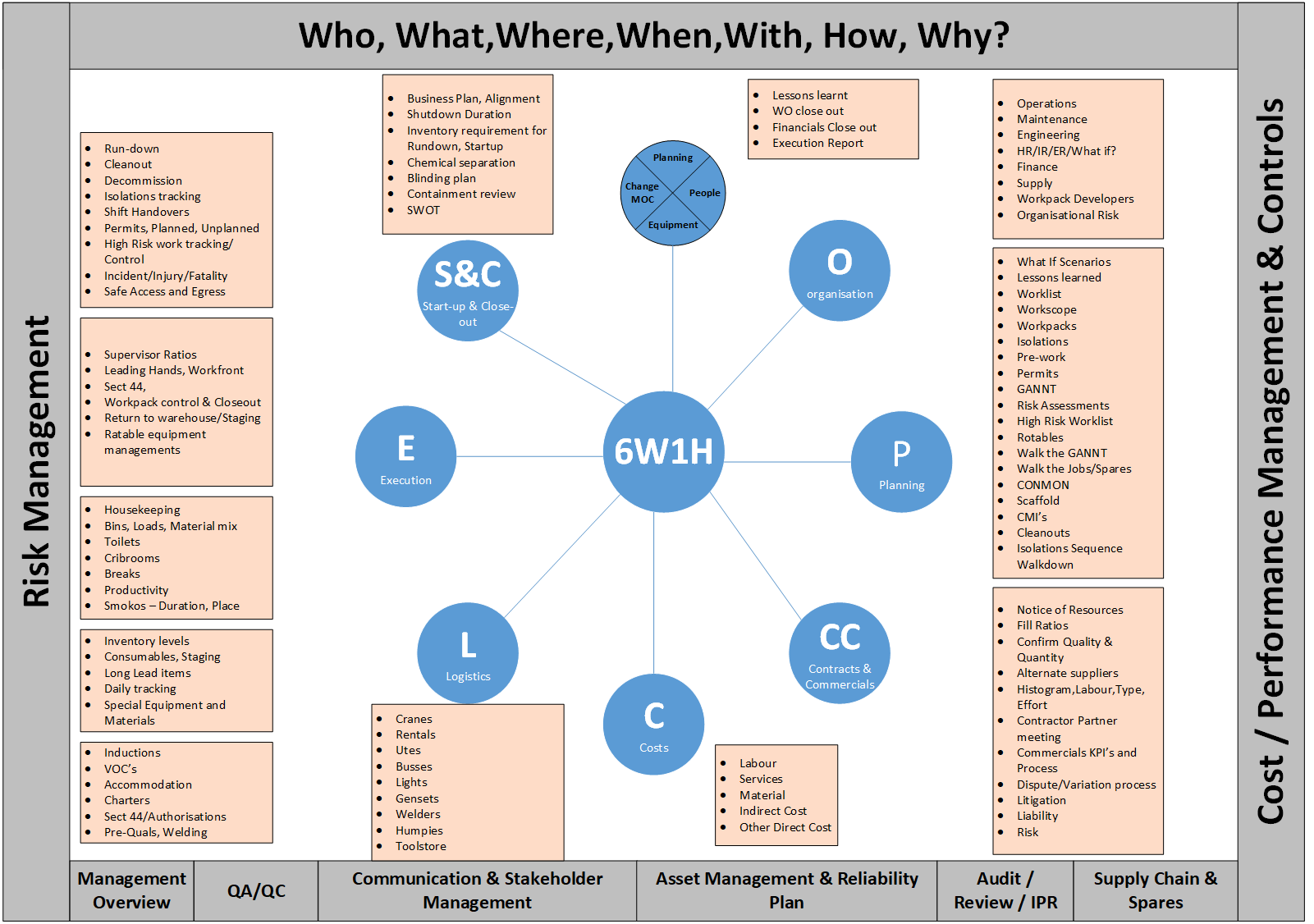
Introduction – Framing the Shutdown with Questions that Matter
The execution of a safe, on-time, and cost-effective shutdown begins with structured planning. This chapter introduces the 6W1H Model a pragmatic framework rooted in best-practice principles from shutdown planning case studies, including BHP, Worsley, and the NKW Nickel Refinery. The model asks seven essential questions: Who, What, Where, When, With, How, Why? and uses them to anchor all dimensions of shutdown readiness and execution.
When integrated with the STO Framework and supported by the Planning, Labour, Inventory, and Leadership enablers, 6W1H becomes more than a checklist it becomes a shared mental model for outage delivery.
Overview of the 6W1H Elements
At the heart of the diagram lies the 6W1H hub, surrounded by seven execution domains:
- S&C – Start-up and Close-Out
- O – Organisation
- P – Planning
- CC – Contracts and Commercials
- C – Costs
- L – Logistics
- E – Execution
Each domain is broken into key sub-elements, forming a matrix of strategic decisions and tactical actions aligned to the asset lifecycle and shutdown stages defined in the GFMAM and ISO 55001 models.
S&C – Start-Up and Close-Out
Planning for shutdown must include how you start and how you finish.
Start-Up Planning Includes:
- Rundown sequencing
- Decontamination
- Permit sequencing
- High-risk isolation clearance
- Shift and supervision alignment
Close-Out Must Address:
- Lessons learned sessions
- Financial closure and Work Order completion
- Final inspections and restart readiness
- Incident reporting and post-job HAZARD closure
- Executive summary and stakeholder briefings
Best Practice Reference: In the Nickel Refinery case study, late handovers and incomplete de-isolations were responsible for a 36-hour delay. This highlights the criticality of S&C as a formal stage with defined ownership and quality gates.
O – Organisation
Organisation defines who owns what across maintenance, operations, engineering, supply, HR, finance, and HSE.
Organisation Focus Areas:
- Clear workfront ownership
- Workpack development roles
- Risk ownership maps
- Communication channels and accountability trees
- Escalation paths and roles under pressure
Integration Point: This aligns with STO Phase 2 “Organisation and Governance” where sponsor, SPA, and shutdown coordinators are formally assigned.
P – Planning
Planning represents the structural foundation of any shutdown. It includes everything from strategic alignment to field-level coordination.
Planning Activities:
- What-If Scenarios
- Worklists, Rotables, and Prework
- Permits and risk assessments
- CMIs and walkdowns
- Isolation maps and clearance
- Gantt creation, sequencing, and validation
- Field QA & workface readiness (TTT, 5W1H)
Best Practice Reference: Our shutdown case reviews show that poor prework and inaccurate planning were responsible for 60% of emergent work during execution. Early mobilisation of planning engineers is critical.
CC – Contracts and Commercials
Commercial misalignment during shutdowns causes claims, rework, and litigation.
Commercial Controls Include:
- Notice of Resources (NOR) timing
- Skill mix validation (labour histograms)
- Partner engagement plans and KPIs
- Risk registers and contingency logs
- Litigation and liability escalation flows
Best Practice Reference: In the BHP-led STO audit, claims due to contractor confusion on scope value exceeded $2.2 million. Contractual clarity and a shared Scope of Work register are non-negotiable.
C – Costs
Costs are often seen as a result, but must be treated as a control function during planning.
Cost Planning Includes:
- Labour, material, indirects, overheads
- Budget allocation vs. spend authority
- Daily burn tracking
- Cost vs. schedule impact logs
- Cost per tag/item for work package analysis
STO Integration: This aligns with GFMAM Enabler 5 – “Asset Cost and Risk Information.” Costs must be reported by unit, not just department.
L – Logistics
Logistics often represents the greatest invisible risk to outage execution.
Logistics Considerations:
- Inductions, VOs, accommodation
- Toolstore and special equipment
- People movement and cribroom availability
- Storage and staging of consumables
- Material flow from warehouse to workface
Case Insight: During the Worsley 2020 outage, logistics bottlenecks delayed three workfronts by 2 shifts due to inadequate accommodation planning. Early visualisation of resource density is essential.
E – Execution
Execution is the high-visibility phase, but only succeeds with upstream clarity.
Execution Focus:
- Supervisor ratios and field leadership quality
- Shift coverage, isolation status, permit flows
- Workfront verification and daily productivity
- Real-time field updates and permit refresh
- Safety, toolbox, and clean work zone culture
STO Framework: This is Phase 5 – “Execution.” Leaders must ensure continuous confirmation of control points across each shift.
Supporting Enablers: Bottom Bar Integration
The foundation for 6W1H delivery includes:
- Management Overview: Strategic clarity and leadership alignment
- QA/QC: Risk-based quality assurance at workfronts
- Communication & Stakeholders: Cross-functional readiness and coordination
- Asset Management & Reliability Plan: Lifecycle visibility and equipment criticality
- Audit/Review: Post-event insights and compliance feedback
- Supply Chain & Spares: Material readiness and vendor performance tracking
Each enabler aligns directly with the appropriate domain of the 6W1H hub, creating a fully integrated system.
Start-up and Close-Out
- Rundown sequencing, decontamination, permit sequencing, high-risk isolation, and shift alignment addressed up front.
- Close-out includes lessons learned, financial close, inspections, restart readiness, incident closure, and executive reporting.
- Late handovers and incomplete de-isolations can be major delay drivers when not formally controlled.
Organisation
- Defines ownership across maintenance, operations, engineering, supply, HR, finance, and HSE.
- Clarifies workpack roles, risk ownership, communication channels, and escalation paths.
- Supports governance by formalising sponsor and shutdown coordination roles.
Planning
- Includes what-if scenarios, worklists, rotables, prework, permits, risk assessments, walkdowns, isolations, Gantt sequencing, and field QA readiness.
- Poor prework and inaccurate planning drive a large share of emergent work during execution.
Contracts, Commercials, Costs, Logistics, and Execution
- Commercial controls address resource notices, skill mix, partner KPIs, contingency logs, and claims exposure.
- Cost controls cover labour, material, indirects, spend authority, daily burn tracking, and cost-to-schedule impact.
- Logistics controls cover inductions, accommodation, tools, special equipment, staging, and warehouse-to-workface flow.
- Execution controls include supervisor ratios, permit flows, shift coverage, workfront verification, productivity, and safety culture.
Supporting Enablers
Management overview, QA/QC, stakeholder communication, reliability plans, audit and review, and supply chain readiness support the model, creating a complete shutdown operating system rather than a standalone planning checklist.
Conclusion – Structured Planning, Sustainable Performance
The 6W1H model brings precision and clarity to the most complex operational undertakings. It is not a theoretical overlay it is a proven framework that empowers shutdown leaders to align execution with expectation. By using this structured model to ask the right questions at the right time, shutdown teams can:
- Reduce emergent work
- Eliminate safety blind spots
- Improve workface productivity
- Strengthen stakeholder confidence
When embedded into STO training and planning routines, 6W1H drives visibility, ownership, and outcomes across all pillars of shutdown success.
Framework Structure
The 6W1H hub is surrounded by seven execution domains: Start-up and Close-Out, Organisation, Planning, Contracts and Commercials, Costs, Logistics, and Execution.
Executive Summary
Independent Peer Review (IPR) is a structured, third-party assurance methodology designed to assess the planning and execution readiness of major shutdowns. By leveraging impartial and experienced reviewers, IPR enhances decision-making confidence, mitigates execution risk, and ensures alignment with shutdown strategy, scope, and business outcomes. It acts as a governance gateway, validating that pre-defined performance, safety, schedule, and quality parameters are realistic and achievable.
Purpose of IPR in Shutdowns
The IPR process is intended to:
- Provide an objective readiness assessment of shutdown plans.
- Identify gaps in planning across safety, scope, resource, and quality domains.
- Confirm the closure of prior recommendations and lessons learned.
- Strengthen confidence in shutdown execution and minimize overrun risk.
- Facilitate stakeholder alignment and reinforce governance through independent validation.
Global Context and Industry Relevance
Research from the Construction Industry Institute (CII), McKinsey & Co., and industry-specific literature highlights the correlation between front-end planning maturity and project shutdown success. Global operators such as Rio Tinto, BHP, and Chevron use peer reviews as a gate process to validate readiness before progressing to execution phases. The IPR is increasingly recognized as an integral element of world-class shutdown execution frameworks, aligned with ISO 55001 Clause 8 and GFMAM subject groups such as Risk Management, Lifecycle Delivery, and Asset Management Decision Making.
IPR Methodology
The IPR process follows a systematic approach consisting of:
Preparation and Engagement
- Define IPR scope (e.g., Shutdown Planning Framework, high-risk scopes, critical path tasks).
- Nominate experienced independent reviewers (technical SMEs, safety, project controls).
- Develop and issue the IPR checklist and document request pack.
Evidence Collection and Review
- Conduct structured interviews with key stakeholders (Shutdown Managers, HSE, Maintenance, Engineering).
- Review planning artefacts (Gantt charts, risk registers, budget baselines, work packs).
- Use scoring rubrics (-2 to +2) across ~20 thematic areas including scope management, safety, and logistics.
Workshop and Rating
- Host an IPR workshop to validate preliminary findings.
- Rate planning readiness in line with thresholds (e.g., 0 = compliant, -1 = improvement needed).
- Identify shutdown overrun risk using consequence and likelihood ratings.
Reporting and Action Closure
- Document IPR findings with summary ratings, risks, and improvement actions.
- Assign ownership and due dates.
- Track close-out through re-review or readiness checkpoint.
IPR Scope of Assessment
Based on benchmarking of the Wodgina and Port IPRs, IPR typically evaluates the following:
|
Domain |
Key Evaluation Points |
|
General Management |
Business case validation, shutdown KPIs, Steering Committee governance |
|
Scope Management |
Scope freeze, critical path identification, change control |
|
Safety Management |
SMP development, risk registers, confined space and isolation plans |
|
Resources & Organisation |
Contractor capacity, site mobilisation plans, 24-hour coverage |
|
Quality Assurance |
Work packs, Inspection & Test Plans (ITPs), OEM engagement |
|
Cost & Budget Control |
First-principles estimation, budget range analysis, man-hour tracking |
|
Logistics & Materials |
Tooling, crane plans, laydown areas, temporary utilities |
|
Communication |
Shift handover, stakeholder updates, emergency response briefings |
|
Shutdown Execution Risk |
Overrun likelihood, weather and SIMOPs exposure, contingency planning |
Insights from Practice: Wodgina and Port IPRs
- At Wodgina, the IPR identified incomplete QA/QC coverage and immature safety leadership visibility. Mitigation included engaging OEMs for ITP development and external safety SMEs.
- At the Port, IPR results showed scope churn (30%), inadequate ITP frameworks, and incomplete resource plans. Remedial actions addressed planning gaps, communication improvements, and explicit documentation of Wharf closure safety controls.
Shutdown Overrun Risk Ratings
IPR processes typically incorporate a formal Shutdown Overrun Risk assessment. This includes:
- Estimating variance likelihood (e.g., >60% = “Likely”).
- Evaluating consequence categories (e.g., 10% delay = “Minor”).
- Using project risk rating matrices to assign a Residual Risk Rating (RRR), guiding mitigation.
Enabling Better Outcomes through IPR
The key contributions of IPR to shutdown performance include:
- Improved Governance: A third-party lens challenges assumptions, validates scope maturity, and enhances accountability.
- Quality Uplift: Highlights weak inspection regimes, lack of ITPs, and helps develop QA/QC roadmaps with OEMs.
- Safety Enhancement: Ensures risks are visible, work packs are verified, and high-risk tasks are independently reviewed.
- Schedule Realism: Validates Gantt alignment with workforce capability and environmental constraints (e.g., Pilbara wet season).
- Continuous Improvement: Closes the loop on lessons learned and accelerates maturity via comparison across sites and time.
Integrating IPR into the Shutdown Framework
For consistent execution, IPR should be formalized as a Stage-Gate before execution readiness. A recommended model includes:
- T-12 to T-6 weeks: Preliminary IPR (planning verification, scope clarity)
- T-4 weeks: Final IPR checkpoint (readiness scorecard, close-out validation)
- T+2 weeks: Post-shutdown IPR (lessons learned, performance review)
IPR Tools and Artefacts
The following tools support effective IPR execution:
- IPR Workbook (structured Excel tool with 100+ evaluation points)
- IPR Summary Memo (high-level risk rating and recommendations)
- IPR Evidence Register (track document sighting and observations)
- IPR Action Tracker (assign ownership, status, and due dates)
Conclusion
The Independent Peer Review process is a vital mechanism for de-risking shutdown execution in asset-intensive environments. It offers measurable value through disciplined governance, promotes transparency, and embeds a culture of performance improvement. When embedded as a repeatable step in shutdown lifecycles, IPR not only prevents failure but helps build shutdown excellence over time.
- Provides objective assessment of shutdown readiness.
- Identifies gaps in scope, safety, resource, quality, logistics, and cost planning.
- Confirms closure of prior lessons learned and recommendations.
- Aligns with ISO 55001 Clause 8 and GFMAM subject areas including risk, lifecycle delivery, and decision-making.
Insights from Practice
- Weak QA/QC coverage, immature safety visibility, scope churn, inadequate ITP frameworks, and incomplete resource planning have been identified.
- These findings have driven remediation through OEM support, improved communication, stronger planning evidence, and explicit safety controls.
Operational Value
- Improved governance and accountability
- Better quality planning and inspection readiness
- Clearer visibility of high-risk work and shutdown overrun exposure
- Continuous improvement through repeated benchmarking
Executive Summary
In early 2011, the author led a major maintenance shutdown at a large nickel refinery located in regional Western Australia. This planned intervention formed part of the refinery’s broader reliability and asset performance program and was viewed as a key opportunity to embed new delivery practices while maintaining high safety and productivity standards.
The shutdown ran for nine calendar days and was delivered through a hybrid model that combined internal supervision and planning resources with an embedded external delivery partner. More than 1270 individual work orders were completed, spanning mechanical, electrical, structural, piping, cleaning, and inspection disciplines. It was a complex event, involving multiple contractors, tight scheduling windows, and critical interfaces between production, maintenance, and health and safety teams.
Delivery Model and Execution Structure
A blended team structure was adopted to balance internal ownership with external expertise. The refinery’s asset engineers, planning leads, and operations representatives formed the leadership core, supported by a shutdown delivery partner responsible for supervision, logistics coordination, and performance tracking.
Each contractor group was assigned discrete work zones, and a centralized control system was set up to enable daily coordination. Materials were pre-staged, and a logistics lead managed tool cribs, scaffold delivery, and contractor mobilisation. A visual war-room environment was maintained on-site, giving all supervisors real-time access to shutdown progress metrics.
Safety and Performance Results
Safety was a key focus throughout. No significant incidents or injuries occurred. Every morning began with structured toolbox talks and pre-start briefings, and frontline leadership actively reinforced Take 5s, JHAs, and hazard reporting. Field audits and spot checks were carried out daily, reinforcing a strong safety culture from day one through demobilisation.
Approximately 93% of the planned scope was completed within the scheduled window. A small number of tasks were deferred due to material delays, late discovery work, or extended QA inspection durations. These were captured, rolled into post-shutdown action plans, and managed without affecting the plant’s restart schedule.
The shutdown was delivered on time and within a 6% variance from the initial cost forecast. Daily review forums were used to approve any variations, and the use of fixed-rate and schedule-of-rates contracts ensured tight financial control. Real-time dashboards, linked to live data inputs from each work front, gave visibility to both commercial and operational metrics throughout the event.
Coordination and Planning Outcomes
The scope freeze milestone was achieved four weeks prior to shutdown commencement. This enabled early material procurement, contractor scheduling, and fabrication work to progress in parallel. Planning walkthroughs were held with safety, operations, and technical teams to challenge the scope, confirm deliverability, and validate constraints.
A detailed readiness tracker was maintained in the lead-up, measuring permits, drawing availability, labour assignments, and logistics milestones. This became a valuable reference point to escalate and close out gaps during the final fortnight of mobilisation.
During the shutdown, whiteboard meetings were held each morning with all supervisors, followed by afternoon lookahead sessions to validate handovers and manage day-to-day emergent risks. Issues such as late scaffold, part delivery delays, and testing bottlenecks were captured through a shared action log and escalated promptly through a single point of accountability.
What Worked Well
Several elements of the shutdown stood out as contributing factors to its success:
- The embedded delivery partner worked seamlessly within the refinery structure, enabling agile problem-solving and eliminating unnecessary contractor coordination layers.
- Pre-fabrication of components significantly reduced field weld time and eliminated delays from rework.
- The use of a visual dashboard and performance tracker increased alignment and allowed real-time performance management.
- Clear accountability, supported by structured role definitions, helped frontline supervisors make immediate decisions with confidence.
Areas for Improvement
Despite the successful delivery, several improvement opportunities were noted:
- Material delivery lead times from external vendors proved inconsistent. A more rigorous early verification process will be adopted for future events to ensure alignment with mobilisation sequencing.
- Quality inspection workflows created bottlenecks, particularly with third-party testing. These will be streamlined, with earlier engagement from inspection vendors and buffer time allowed in planning.
- Scope maturity at the freeze milestone, while improved, can benefit from earlier engagement in the pre-planning stage to reduce late-stage changes and contingency use.
Close-Out Process
A structured close-out was conducted within one week of plant restart. All contractors and delivery leads participated in lessons learned sessions, with actions recorded and assigned for follow-up. A formal close-out report was produced, including the completed scope breakdown, variance log, key issues register, and a full suite of shutdown KPIs.
This event demonstrated that mature shutdown outcomes can be achieved through disciplined planning, clear leadership, and consistent communication. More importantly, it validated that the delivery model anchored in internal ownership with targeted external expertise provides the flexibility and control required in complex industrial environments.
The author’s approach throughout reflected the principles advocated by global shutdown experts. The visual control, daily alignment, and execution focus mirror the teachings of Ted J. Lister’s DEC model. The structured pre-shutdown planning and readiness process reflect Joel Levitt’s lifecycle-driven shutdown philosophy. Safety-first leadership, embedded logistics, and clear scope management reflect the best of Tom Lenahan’s and Bobby Singh’s writings.
This case, delivered in full alignment with those principles, affirms the importance of integrating field intelligence with structured delivery models. It offers a strong benchmark for similar industrial operations seeking to build capability and repeatable success in shutdown execution.
What did we do differently?
This case study presents a major refinery shutdown delivered through a blended internal and external delivery model. The shutdown lasted nine calendar days and completed more than 1,270 work orders across mechanical, electrical, structural, piping, cleaning, and inspection disciplines.
The key achievement was disciplined execution: on-time delivery, no significant injuries, and cost performance within a 6 percent variance despite a complex contractor environment and multiple critical interfaces.
Delivery Model and Coordination
- Internal engineering, operations, and planning leadership.
- Embedded shutdown delivery partner for supervision, logistics coordination, and performance tracking.
- Defined contractor work zones.
- Central control system and visual war room for daily alignment.
- Pre-staged materials and actively managed logistics.
Safety and Performance
- No significant incidents or injuries.
- Toolbox talks, pre-starts, field audits, and hazard reporting reinforced daily.
- Approximately 93 percent of planned scope completed inside the scheduled window.
- Deferred tasks isolated and managed without affecting restart.
- Cost remained within a 6 percent variance of forecast through daily review and contract control.
Planning and Readiness Controls
- Scope freeze achieved four weeks ahead of shutdown.
- Readiness tracker used to manage permits, drawings, labour, and logistics.
- Morning whiteboard meetings and afternoon look-aheads controlled handovers and emergent issues.
What Worked Well
- Embedded delivery partner worked seamlessly within site structures.
- Pre-fabrication reduced field weld time and rework.
- Visual dashboards improved real-time performance management.
- Role clarity gave supervisors confidence to act quickly.
Improvement Opportunities
- Earlier vendor material verification required.
- Quality inspection workflows need earlier engagement and more float.
- Scope maturity benefits from earlier pre-planning engagement.
Conclusion
This case demonstrates that mature turnaround outcomes are achieved through disciplined planning, clear leadership, active logistics coordination, and strong field execution. The operating benefit is repeatable control under pressure, not just a single successful shutdown.
Executive Summary
This case study shows how a structured post-shutdown workshop can convert operational experience into practical improvement actions. A facilitated review brought maintenance, operations, planning, HSE, and contractors together to identify recurring breakdowns, validate strengths, and agree improvement priorities for the next cycle.
Location: Large Iron Ore Miner, Western Australia
Facilitator: Shutdown Lead (Author)
In the aftermath of a complex multi-area shutdown across OHP and TLO facilities, a structured improvement workshop was convened at a major iron ore mining operation in Western Australia. The workshop was led by the author, a seasoned shutdown manager, to capture learnings, benchmark performance, and facilitate continuous improvement across all phases of the shutdown.
The session followed an open and collaborative format. Participants from maintenance, operations, planning, HSE, and contracting teams were engaged in identifying issues, surfacing constraints, and proposing improvements based on firsthand experience. A clear set of expectations was established at the outset focused on shared ownership, alignment with a 14-week shutdown framework, simplicity in execution, and clarity of communication. The team reiterated a common vision: “Get it right, together.”
Thematic Learnings and Observations
The review process identified eight recurring themes that influenced shutdown performance:
Tool Time & Task Planning:
Work scoping and planning needed refinement. Task durations often did not match field realities. Non-value-adding activities like waiting for isolations or tooling eroded productive time. Clear scope boundaries, realistic timeframes, and improved planning discipline were recommended.
Task Preparation & Site Readiness:
Workfronts were occasionally unprepared due to gaps in tooling, access, and work package clarity. The team recognised the need for proactive site inspections, staging of parts, and clearer task sequencing.
Isolation and Lock-Out Practices:
Isolations presented delays due to equipment tagging issues, misalignment between rostered staff and demand, and outdated lock-box equipment. A systemic approach to isolation sequencing and resource allocation was recommended.
Ramp Down and Ramp Up Phases:
The transitions into and out of the shutdown were highlighted as weak points. Pre-cleaning, equipment readiness, handover protocols, and clear phase ownership (between operations and maintenance) were not consistently applied.
Scaffolding and Shared Resources:
Cranes and scaffolding access emerged as major bottlenecks. Misalignment in work crew Gantt charts, limited crane availability, and repetitive scaffolding needs contributed to inefficiencies. Standardisation of scaffold design and a centralised lift study coordination were key takeaways.
Supervision and Schedule Compliance:
A lack of confidence in Gantt chart accuracy and limited field presence by some supervisors led to missed milestones and reactive decisions. Training on shutdown planning tools, expectations of accountability, and shift handover improvements were flagged as solutions.
Skills and Competency Gaps:
Variability in contractor capabilities, low retention, and insufficient mentoring were noted. A structured skills matrix, embedded technical coaching, and formal step-up processes were proposed.
Work Scope Discipline:
Emerging work, rework, and poor visibility of historical scope plagued shutdown execution. Stronger gate reviews, evidence-based scoping, and scope freeze enforcement were marked as critical improvements.
Outcomes and Way Forward
The workshop also highlighted strengths: improved hazard ID rates, visible safety leadership, tidy work fronts, and effective material readiness in some areas. However, issues such as poor communication, unclear ownership of tasks, and limited post-shutdown reviews diluted performance.
The team adopted a series of action plans, including:
- Clearer escalation protocols and shutdown authority structure
- Integration of pre-works into Gantt from T-minus 2 weeks
- Scaffold reusability designs and shared resource plans
- Enhanced shutdown onboarding focused on site knowledge and process discipline
- Visual management of shutdown phases using laminated phase cards and team task boards
This reflective exercise reinforced that shutdown performance hinges on integration, visibility, ownership, and learning. The 14-week model was re-endorsed as the preferred governance framework, but the need for disciplined application and cross-functional accountability was recognised. The review concluded with a collective commitment to embed these lessons into the next planning cycle, with the author continuing in the lead facilitator role for upcoming shutdowns.
Workshop Method
The session was deliberately open and collaborative, with expectations of shared ownership, alignment to a 14-week shutdown framework, simplicity in execution, and clarity in communication.
Key Themes Identified
- Tool time and task planning
- Task preparation and site readiness
- Isolation and lock-out
- Ramp-down and ramp-up
- Scaffolding and shared resources
- Supervision and schedule compliance
- Skills and competency
- Work scope discipline
Strengths and Positive Signals
Improved hazard identification, visible safety leadership, tidy work fronts, and stronger material readiness were confirmed in selected areas.
Actions Adopted
- Clearer escalation protocols and shutdown authority structure
- Integration of preworks into Gantt from two weeks before shutdown
- Reusable scaffold designs and shared resource plans
- Improved onboarding focused on site knowledge and process discipline
- Visual phase management using laminated phase cards and task boards
Conclusion
Shutdown performance improves when review sessions are treated as structured governance events rather than informal debriefs. The operating benefit is stronger integration, visibility, ownership, and learning across the next planning cycle.
Executive Summary
This case study frames the shutdown supervisor role as the operational control point where plan quality, permit discipline, productivity, safety, and communication converge. The shutdown supervisor does not simply allocate work. The role holds the daily execution rhythm together.
Led by the Author – Large Iron Ore Miner, Western Australia
As part of a broader effort to uplift execution standards and field leadership capability, the author facilitated a detailed observational case study commonly referred to as a DITLO (Day in the Life Of) focusing on the role of a shutdown supervisor during a major maintenance outage at a large iron ore mining operation in Western Australia. The aim was to clarify responsibilities, optimise productivity, and formalise the frontline behaviours required to achieve safe, high-quality, and predictable shutdown performance.
The DITLO assessment began the day before the shift, with the supervisor reviewing the next day’s work alongside the planner. This included verifying that all required tools, permits, materials, and isolations were in place, and ensuring that technicians would receive a clear work brief the following morning. This preparation set the tone for efficiency, as the supervisor’s objective was to eliminate delays and uncertainty at the start of the shift.
Day in the Life of a Shutdown Supervisor (DITLO)
Typical 12-Hour Day – 16 Key Steps
Large Iron Ore Miner – Western Australia | bserved and Facilitated by the Author
Day Before the Shift
- T-24 hrs – Review work packs and isolations with the planner
- Ensure all materials, permits, isolations, and tools are prepared for next-day work
- Confirm crews will receive accurate scope and site setup
04:00 – Early Arrival and Readiness Check
- Verify overnight changes and confirm work status
- Check permit boards and isolation boards
- Stage documentation and job packs for shift commencement
05:00 – Handover from Night Shift
- Attend site with outgoing supervisor
- Confirm isolation handover, job progress, and active permits
- Verify any outstanding safety actions
06:00 – Pre-Start Briefing
- Breathalyser testing, fatigue check, and roll call
- Deliver safety briefing (hazards, hot work, confined space, etc.)
- Communicate critical work areas and shift goals
- Conduct stretch-and-flex and assign crews
06:30 – Job Verification and Site Walkdowns
- Confirm:
- Isolations locked and tagged
- Permits signed and approved
- Confined space entries tested and cleared
- Work fronts safe and controlled
- Begin first supervision round
07:00–10:00 – Field Supervision and Observations
- Visit top 6–10 high-priority work locations
- Conduct:
- Job readiness and permit compliance checks
- 10:1 coaching with trades/contractors
- Safe Act Observations (SAO), Critical Control Observations (CCO)
- Ensure good material staging, workspace setup, and time-on-tools
10:00–10:30 – Crib Break Supervision
- Monitor shift adherence to break schedule
- Use time to update shutdown board and prep for meeting
10:30–11:30 – Shutdown Progress Meeting
- Attend daily coordination meeting with SMO team
- Report job status, constraints, and Gantt chart variances
- Update whiteboards and dashboards
- Escalate risks and confirm support needs
11:30–13:00 – Afternoon Site Check and Spot Audits
- Revisit critical jobs for QA/QC signoffs
- Verify confined space and hot work compliance
- Check scaffold integrity and lifting permits
- Inspect gas cylinders, welding bays, and electrical energisation
13:00–14:30 – Progress Update to Planners and Execution Lead
- Reconcile job progress with plan
- Review time and performance metrics (tool-time, job status, delays)
- Confirm logistics for emergent work and upcoming jobs
14:30–15:00 – Crib and Refresh
- Use break to finalise night shift handover prep
- Review safety actions and outstanding permits
15:00–16:00 – Night Shift Preparation
- Stage tools, equipment, and work packs
- Confirm permit packs and isolation sheets ready
- Arrange crane schedules, scaffold setups, transport logistics
16:00–17:00 – Shutdown Control Room Update
- Upload manual progress notes into control system
- Ensure shutdown metrics are current (safety, tool-time, scope)
- Conduct daily readiness check with SMO superintendent
17:00–18:00 – Final Job Audits and Field Verifications
- Reinspect high-risk work and job close-outs
- Confirm LOTO, barricades, and equipment reinstatement
- Walk down with supervisors where required
18:00–18:30 – Handover to Night Shift
- Conduct structured hot-seat handover
- Brief incoming crews on active permits, risks, and job progress
- Sign off on shift documentation
What Not to Do – Tasks Assigned Elsewhere
Avoid distractions like:
- HR issues, timekeeping, swipe cards (→ Resource Coordinator)
- D&A testing, training checks (→ Health & Safety)
- Spare parts chasing (→ Shutdown Planners/SMO)
Focus remains on:
Field supervision, safety, scope execution, and team performance
- Throughout the shift, the supervisor maintained consistent communication with work crews, prioritising critical job updates, validating safety procedures, and escalating emerging risks before they impacted production. They also ensured toolbox training (TTT), Safe Act Observations (SAO), and Critical Control Observations (CCO) were conducted in line with behavioural safety programs. At the end of the shift, a structured hot-seat handover was conducted at the permit board. The outgoing crew debriefed the incoming team, signed off permits, and briefed supervisors on all active job statuses.
- Importantly, the case study also clarified what a shutdown supervisor should not be doing. Administrative tasks such as training verification, HR issues, drug and alcohol testing, and swipe card access were explicitly excluded and assigned to the SMO Superintendent or Resource Coordinator. Similarly, tasks such as chasing spares or resolving personnel issues were delegated, allowing the supervisor to focus fully on field execution and leadership.
- The findings of this DITLO confirmed that effective shutdown supervision requires structured planning, strong job readiness controls, visible leadership, and proactive issue resolution. The success of this model depended on disciplined handovers, clear communication rhythms, and a relentless focus on tool-time, safety, and quality. The author’s leadership in documenting and institutionalising this best practice helped set a new standard for shutdown execution across the business.
- This DITLO study also drew from sources including GPAllied, Ricky Smith, COAA, CWFP, and the company’s own 1SAP and CMFP systems. It stands as a strong example of how targeted leadership development and standardised routines can elevate shutdown delivery and foster high-performance maintenance culture in complex, high-risk industrial environments.
Daily Rhythm of Control
- Confirm crew mobilisation, permit status, isolations, tools, parts, and access before the shift accelerates.
- Attend pre-start and coordination meetings with a clear view of priorities, interfaces, and emerging risks.
- Maintain direct field presence to validate progress, remove barriers, and reinforce safety expectations.
- Balance schedule pressure with quality and hold-point discipline.
- Close the loop at end of shift through handovers, progress updates, and constraint escalation.
Core Competencies
- Workfront readiness assessment
- Contractor coordination and crew discipline
- Permit and isolation awareness
- Progress tracking against plan
- Escalation of delays, quality issues, and safety concerns
Operating Benefit
When the shutdown supervisor role is disciplined and visible, work starts cleaner, crews lose less time, defects are reduced, and schedule recovery becomes faster. The role is critical to turning a shutdown plan into reliable field execution.
Conclusion
This case study shows that the shutdown supervisor is not an administrative role. It is one of the most important operational control positions in the outage environment, linking leadership intent to workface performance.
Executive Summary
This case study focuses on the second-layer value of shutdown review workshops: governance reset. Beyond operational lessons, the workshop process can be used to re-establish decision rights, planning accountabilities, sponsor visibility, and risk ownership for the next cycle.
Location: Large Iron Ore Miner, Western Australia
Facilitator: Shutdown Lead (Author)
In the aftermath of a complex multi-area shutdown across OHP and TLO facilities, a structured improvement workshop was convened at a major iron ore mining operation in Western Australia. The workshop was led by the author, a seasoned shutdown manager, to capture learnings, benchmark performance, and facilitate continuous improvement across all phases of the shutdown.
The session followed an open and collaborative format. Participants from maintenance, operations, planning, HSE, and contracting teams were engaged in identifying issues, surfacing constraints, and proposing improvements based on firsthand experience. A clear set of expectations was established at the outset focused on shared ownership, alignment with a 14-week shutdown framework, simplicity in execution, and clarity of communication. The team reiterated a common vision: “Get it right, together.”
Thematic Learnings and Observations
The review process identified eight recurring themes that influenced shutdown performance:
Tool Time & Task Planning:
Work scoping and planning needed refinement. Task durations often did not match field realities. Non-value-adding activities like waiting for isolations or tooling eroded productive time. Clear scope boundaries, realistic timeframes, and improved planning discipline were recommended.
Task Preparation & Site Readiness:
Workfronts were occasionally unprepared due to gaps in tooling, access, and work package clarity. The team recognised the need for proactive site inspections, staging of parts, and clearer task sequencing.
Isolation and Lock-Out Practices:
Isolations presented delays due to equipment tagging issues, misalignment between rostered staff and demand, and outdated lock-box equipment. A systemic approach to isolation sequencing and resource allocation was recommended.
Ramp Down and Ramp Up Phases:
The transitions into and out of the shutdown were highlighted as weak points. Pre-cleaning, equipment readiness, handover protocols, and clear phase ownership (between operations and maintenance) were not consistently applied.
Scaffolding and Shared Resources:
Cranes and scaffolding access emerged as major bottlenecks. Misalignment in work crew Gantt charts, limited crane availability, and repetitive scaffolding needs contributed to inefficiencies. Standardisation of scaffold design and a centralised lift study coordination were key takeaways.
Supervision and Schedule Compliance:
A lack of confidence in Gantt chart accuracy and limited field presence by some supervisors led to missed milestones and reactive decisions. Training on shutdown planning tools, expectations of accountability, and shift handover improvements were flagged as solutions.
Skills and Competency Gaps:
Variability in contractor capabilities, low retention, and insufficient mentoring were noted. A structured skills matrix, embedded technical coaching, and formal step-up processes were proposed.
Work Scope Discipline:
Emerging work, rework, and poor visibility of historical scope plagued shutdown execution. Stronger gate reviews, evidence-based scoping, and scope freeze enforcement were marked as critical improvements.
Outcomes and Way Forward
The workshop also highlighted strengths: improved hazard ID rates, visible safety leadership, tidy work fronts, and effective material readiness in some areas. However, issues such as poor communication, unclear ownership of tasks, and limited post-shutdown reviews diluted performance.
The team adopted a series of action plans, including:
- Clearer escalation protocols and shutdown authority structure
- Integration of pre-works into Gantt from T-minus 2 weeks
- Scaffold reusability designs and shared resource plans
- Enhanced shutdown onboarding focused on site knowledge and process discipline
- Visual management of shutdown phases using laminated phase cards and team task boards
This reflective exercise reinforced that shutdown performance hinges on integration, visibility, ownership, and learning. The 14-week model was re-endorsed as the preferred governance framework, but the need for disciplined application and cross-functional accountability was recognised. The review concluded with a collective commitment to embed these lessons into the next planning cycle, with the author continuing in the lead facilitator role for upcoming shutdowns.
Governance Gaps Typically Exposed
- Unclear scope approval and escalation boundaries
- Inconsistent shutdown sponsor visibility
- Weak ownership of logistics and contractor readiness
- Unresolved actions from previous outages
- Poor integration between shutdown reporting and management review
Reset Actions
- Formalise stage-gates and review checkpoints
- Clarify who approves scope additions and schedule changes
- Set mandatory closure dates for lessons learned actions
- Integrate review outputs into the next shutdown master plan
Conclusion
Used well, a shutdown review workshop resets governance, clarifies leadership expectations, and improves the control environment for the next outage. That makes it a strategic management tool, not just a retrospective meeting.
Executive Summary
This case study captures the structured development of a shutdown playbook for a large mining operation in Western Australia. The work translated shutdown knowledge, leadership expectations, planning disciplines, and execution controls into a repeatable operating manual that could be used across sites and teams.
The result was a more consistent shutdown language, clearer governance, faster onboarding of new leaders, and improved transfer of proven practices into execution.
Playbook Design Intent
In response to recurring inconsistencies in shutdown delivery across several operations, a large iron ore producer in Western Australia initiated a transformative effort to standardise shutdown performance. The author was appointed to lead this effort, in collaboration with consultants from McKinsey & Company. The objective was to develop and embed a practical, scalable Shutdown Playbook that could be applied consistently across the company’s Western Australian assets.
The first priority was to address gaps in planning and execution predictability. A visual management system, called the “Planning War Room,” was established to synchronise the shutdown lifecycle over a structured 12-week horizon. The War Room was designed to centralise information, provide visual cues on planning progress, and enable timely escalation of risks. It provided a physical hub for daily readiness checks, scheduling updates, and problem-solving discussions. A visual tracker displayed key milestones, including scope freeze, procurement readiness, contractor mobilisation, and permit controls. These components gave leaders, from superintendents to general managers, a real-time window into shutdown readiness.
Execution capability was uplifted further through the deployment of a “Shift War Room” process during the shutdown event. Four specific shift-based communication rhythms were implemented: handover reviews, daily progress meetings, field leadership engagement, and an emergent work approval process. These activities ensured that field conditions were clearly understood and that schedule risks were rapidly addressed. Daily meetings were structured to report on job status, constraints, and contractor performance using simple, colour-coded visual boards. Field supervisors were empowered to manage issues in real time, while senior leaders had clear escalation paths supported by performance dashboards.
Risk management was also elevated through formal contingency planning. The Playbook introduced pre-mortem workshops to pre-empt high-risk scenarios. Each shutdown underwent tollgate assessments, including executive-level readiness reviews before mobilisation. In some cases, site-wide simulation drills and planning walkdowns were conducted to test critical assumptions and validate logistics. These proactive approaches helped identify gaps early and built delivery confidence across the stakeholder chain.
The Playbook established a rigorous post-shutdown review process that included schedule variance reviews, tool-time analysis, and safety debriefs. Red-yellow-green performance ratings were used to benchmark shutdown outcomes in areas such as scope control, contractor productivity, and rework avoidance. Results were shared across WAIO sites in a common reporting format, enabling performance comparisons and feeding lessons learned into future planning cycles.
One of the most significant changes was the cultural uplift in shutdown leadership. The Playbook explicitly defined roles and responsibilities for each layer of the organisation planners, supervisors, engineers, operations, contractors, and site executives. Leadership presence in the field was made a core expectation, supported by coaching and onboarding aligned with the Playbook structure. Team charters, permit-to-work simplification, and integrated planning with operations ensured a collaborative and aligned execution culture. This people-centric element proved to be critical in bridging the gap between shutdown planning and operational excellence.
The project achieved several outcomes. Tool-time productivity improved due to better job readiness. Schedule adherence increased, especially for critical path jobs. Safety incident rates decreased due to clearer communication and structured field controls. Perhaps most importantly, stakeholders reported greater confidence in shutdown predictability, with a higher degree of coordination and transparency across departments.
Through the author’s leadership and McKinsey’s facilitation, the Shutdown Playbook became a strategic operating standard across the organisation. Its repeatable structure enabled each site to tailor shutdowns while still adhering to shared principles and KPIs. This initiative reinforced that operational discipline, visual leadership, and proactive planning are the foundation for successful shutdown management in asset-intensive industries.
Operating Benefit
The playbook reduced variation between teams, improved role clarity, accelerated supervisor and planner ramp-up, and gave leaders a practical reference for maintaining shutdown discipline under pressure.
Conclusion
A well-structured shutdown playbook is a capability multiplier. It converts experience into organisational discipline and provides a stable operating model that outlasts individual shutdown cycles.
Introduction
Faced with the need to deliver a high-risk, high-complexity refinery shutdown with zero tolerance for delays or safety incidents, a large industrial operation in Western Australia initiated a full overhaul of its shutdown delivery approach. The author was tasked with leading the development and implementation of a comprehensive Shutdown Execution Manual, designed to provide end-to-end coverage of all planning, control, safety, and verification processes. The result was a benchmark document that became a reference point for future events across the enterprise.
Strategic Objective and Context
The primary objective of the execution manual was to embed structure, discipline, and accountability into every phase of shutdown delivery. Recognising past performance gaps such as missed milestones, emergent work chaos, and inefficient tool-time the author designed a plan that would provide clarity across functions, improve field readiness, and ensure safe, quality delivery within cost and schedule targets.
The manual was developed in line with industry best practices from ISO 55000, PMBOK, and references from leading shutdown management literature including works by Tom Lenahan, Joel Levitt, Bobby Singh, and Ted Lister. The framework emphasised governance, leadership presence, execution control, risk and scope management, and contractor alignment.
Manual Development and Structure
The shutdown execution manual was divided into a series of integrated sections covering over 25 distinct activity streams. These included scope freeze controls, permit systems, logistics mobilisation, contractor onboarding, safety reviews, cost tracking, shift reporting, and closeout routines. Each section contained defined roles and responsibilities, checklists, approval gates, and document templates to enable repeatable, scalable execution.
Key chapters included:
- Scope and Risk Definition: Embedded work order validation processes, gate approvals, and freeze milestones.
- Safety Management System: Integrated PTW, JSA, confined space, and high-risk activity tracking.
- Execution Control: Visual war room setup, shift reports, lead indicators, and performance dashboards.
- Leadership Engagement: Clear escalation paths, SMO governance, field coaching expectations, and supervisor DILO routines.
- Contractor Coordination: Onboarding flows, scope allocation matrices, tool readiness tracking, and cost/time monitoring.
- Shutdown Completion & Closeout: Reinstatement protocols, post-event reviews, lessons learned, and KPI reporting.
Benchmarking and Best Practice Integration
Each element of the manual was benchmarked against internal and external comparators. The author engaged peer sites, industry forums, and historical reviews to ensure all control points reflected high-maturity practices. Notable inclusions:
- Turnaround Readiness Reviews with structured Go/No-Go gates at T-90, T-60, and T-30 days.
- Workface Planning Integration, ensuring all jobs were fully packaged, reviewed, and staged with execution logic.
- Emergent Work Management Protocol, including approval matrices, escalation pathways, and resource impact tracking.
- Field Leadership Deployment, drawing from shutdown DILO observations and coaching models to standardise supervision behaviours.
- Systemised Shift Reports, using red/yellow/green (RYG) tracking for each job and integration with shutdown command centre visual boards.
- Closeout Discipline, including contractor reconciliation, final inspections, QA/QC audits, and cross-departmental lessons learned workshops.
These components ensured that the plan moved beyond a static document into a living system of delivery excellence.
Execution and Results
The shutdown was executed over a 21-day window with over 50,000 planned work hours and a multi-contractor workforce exceeding 300 personnel. The use of the execution manual was instrumental in achieving the following results:
- Zero Recordable Injuries
- >98% Scope Completion against frozen baseline
- <3% Emergent Work introduced post-freeze
- No Unplanned Production Losses post start-up
- Full Financial Reconciliation completed within 14 days
Key to success was the ability to visually manage performance, maintain shift discipline, and empower supervisors with clear tools and expectations. The author’s leadership in enforcing the manual’s principles particularly in the areas of scope control, contractor management, and safety governance was credited with lifting shutdown maturity across the organisation.
Conclusion
This case demonstrates the value of a unified, structured shutdown execution manual led by an experienced asset management and operations professional. By embedding best practices, ensuring line-of-sight control, and enabling repeatable high performance, the shutdown transitioned from a high-risk operational event into a disciplined, measurable delivery system.
The manual has since been adopted by other business units and forms part of the organisation’s capital and sustaining maintenance readiness framework. Its impact continues to shape the way large industrial turnarounds are executed in Western Australia and beyond.
Executive Summary
This case study establishes the Shutdown Management Office (SMO) as a permanent organisational capability designed to control, standardise, and continuously improve shutdown performance across multiple assets and operating cycles. The SMO is not a coordination team. It is a governance, planning, assurance, and performance integration function aligned to ISO 55001 lifecycle delivery and GFMAM subjects.
Strategic Intent and Rationale
The strategic intent behind the SMO was to minimise business interruption to the supply chain by executing safe, efficient, and consistent shutdowns across operations. Historically, shutdowns were managed in silos, with inconsistent planning, varying HSE outcomes, and inefficiencies in resource allocation. The SMO created a standardised, scalable, and sustainable model underpinned by shared values, improved planning, and predictable execution.
Key benefits envisioned included greater internal capability through a known and trained workforce, improved HSE performance and less reliance on the external market, central coordination for resource mobilisation, logistics, and communication, and enhanced productivity, reduced duration, and cost savings.
Guiding Principles and Future-State Requirements
- Zero injuries during shutdowns
- Effective resource utilisation and a smooth shutdown profile without negatively impacting volume
- Execute now and optimise later, with staged systems maturity uplift
- Simplify and standardise shutdown execution strategies
- Design a future-ready, scalable operating model
- Deliver quality work that minimises startup time and eliminates rework
- Optimise shutdown resources across the business
- Create consistent shutdown resource and engagement strategy
- Build scalable, repeatable, quality labour and clearly defined interfaces
- Continuously feed learning back into the planning cycle
Organisational Benefits and Portfolio Management
The SMO coordinated shutdown resource requirements across multiple sites as a program. Portfolio management processes were used to establish the best deployment of resources and equipment across mines, align shutdowns with business strategies, communicate financial costs and benefits, and manage shutdowns using a holistic systems approach.
SMO site representatives were allocated to sites as the single point of accountability for delivering a work-ready workforce. They attended shutdown meetings, facilitated job walkdowns, and supported pre-mobilisation coordination. Resource coordinators supported flights, accommodation, and logistics transparency.
Organisational Structure and Roles
- Shutdown Superintendent: site-embedded leader accountable for execution
- Resource Coordinator: managed mobilisation, inductions, VOCs, and logistics
- Long-Term Planner: centrally based and responsible for rolling P80 plans
- Support teams: scheduling, logistics, maintenance systems, and offsite repairs
Process Architecture
The SMO process framework covered eight structured stages: establish and identify work, develop and approve scope, optimise work packages, mobilise resources, execute and monitor, control and amend scope, close out, and review and improve. A D-12 to D+2 week timeline governed activity planning and execution.
Planning and Resource Forecasting
A 24-month rolling operational plan using P80 work forecast methodologies was used to align shutdown timing with equipment criticality and business interruption windows, model standard work to 80 percent, identify leverage points to reduce duration, and resource-level internally and externally.
Organisational benefits:
- The shutdown management office has been established to coordinate the shutdown resource requirements across all the owners mines as a program, portfolio management process are used to establish the best possible deployment of resources and equipment across all mines.
- SPM accomplishes its purpose by adhering to some fundamentals.
- Ensures alignment with business strategies, goals, and objectives
- Communicates portfolio details, including financial costs and benefits
- Manages shutdowns and programs as a whole. It’s a holistic, systems approach to shutdowns
- Identify and scope the portfolio, investigate impacts, analyse data, action plans, monitor and manage change
- As part of the management process the SMO shutdown team superintendents have been allocated to various sites as the SMO site representative. This enables single point of accountability for delivering a work ready workforce for execution of the required work by operations. It enables problem solving and also expediting any issues when they occur. The SMO site representative works closely with the operational shutdown superintendent by attending all shutdown meetings and facilitating job walk down and pre-mobilisation coordination as per CMMS work management mandated requirements.
- The SMO site representative will be supported by a resource coordinator (8/6 B2B) that allows for the mobilisation and coordination or resources, flight, accommodation and logistical requirements.
- The resource coordinator work directly with the operations shutdown superintendent and shutdown coordinator by attending all meetings to allow transparent resource requirements and front end loading outside of operational work.
Organisational Structure and Roles
The SMO model established clear governance and site integration:
- Shutdown Superintendent: Site-embedded leader accountable for execution
- Resource Coordinator: Managed mobilisation, inductions, VOCs, logistics
- Long-Term Planner (LTP): Located in the central office; developed rolling P80 plans
- Support Teams: Covered Scheduling, Logistics, Maintenance Systems, Offsite Repairs
This structure ensured that shutdown planning, execution, and optimisation were embedded into the broader maintenance strategy, fully aligned with SAP (1SAP) systems and integrated planning cycles.
Process Architecture: From Scope to Close-Out
The SMO process framework covered the full shutdown lifecycle in eight structured stages:
- Establish & Identify Work
- Develop & Approve Scope
- Optimise Work Packages
- Mobilise Resources
- Execute & Monitor
- Control & Amend Scope
- Close Out
- Review & Improve
Each phase was underpinned by SAP workflows, clear accountability, and milestone tracking. A D-12 to D+2 week timeline governed activity planning and execution, with key stakeholder reviews built into the process.
Planning & Resource Forecasting
A cornerstone of the SMO model was the development of a 24-month rolling operational plan using P80 work forecast methodologies. These plans were used to:
- Align shutdown timing with equipment criticality and business interruption windows
- Model standard work to 80% and identify leverage points to reduce duration
- Resource level internally and externally, using workforce capability profiles
Execution and Field Supervision
The SMO Execution Team managed:
- Onsite shutdown supervision
- Belt change-outs and critical-path mechanical works
Precision maintenance of internal equipment- Field-based feedback, supervision reports, and critical-path tracking
A major innovation was the use of mobile tool stores, fully stocked and delivered to each site shutdown, which increased productivity and reduced mobilisation time.
Logistics and Mobilisation
Logistics functions included:
- Flight and accommodation booking
- Site access, training, and induction coordination
- Contractor compliance and qualification checking
- Equipment mobilisation and return scheduling
All logistics were handled by the central office and site-based coordinators, reducing complexity and improving fill ratios for internal and contractor labour pools.
Continuous Improvement and Analytics
The author led the integration of data-driven decision-making within the SMO. Key initiatives included:
- Labour productivity analysis and wrench time benchmarking
- Development of standard work recipes
- Shutdown intensity models and forecasting
- KPI dashboards and SAP BW reports
A zero-based budgeting approach was adopted for long-term forecasting, supported by real-time job data collection and 5 Why analysis for all non-conformances.
Leadership, People and Learning Systems
A core success factor was the professionalisation of the shutdown workforce:
- Role descriptions and KPIs for all team members
- Career pathways and training for shutdown professionals
- Scheduler, analyst, and quality surveyor capability uplift
- Integrated feedback loops through quarterly review forums
The SMO became a centre of excellence for building high-performance teams aligned to safety, cost, and volume metrics.
Outcomes and Learnings
The implementation of the SMO delivered measurable outcomes across safety, productivity, and cost:
- Standard shutdown durations reduced by 15–20%
- Increase in planned work compliance and execution precision
- Greater flexibility through internal labour pools
- Enhanced cross-site learnings and shutdown repeatability
Leadership messaging was reinforced through the “Eyes On – Aim Small, Miss Small” principle promoting discipline, focus, and outcome-based shutdown delivery.
Conclusion
The author’s role in designing and deploying the Shutdown Management Office for a large iron ore miner in Western Australia demonstrates how a well-structured, system-integrated model can transform shutdown performance. By aligning people, processes, and technology under one umbrella, the SMO became a benchmark example of excellence in planned maintenance execution across the industry.
Delivery Teams:
SMO Scheduling Team – Role and Purpose
The Scheduling Team within the Shutdown Management Office (SMO) is responsible for translating long-range operational strategies into executable, resource-aligned maintenance plans across a 24-month horizon. The team works closely with Mine Operations to model standard work to an 80% maturity level, assess workforce capability, and establish resource-levelled, risk-informed maintenance schedules.
Key Responsibilities
- Operational Plan Translation
Convert the strategic Operational Plan into a rolling 24-month schedule, aligning both internal and external labour to forecasted maintenance and business interruption windows. - Resource Capability Modelling
Evaluate workforce availability and capability across operations to create accurate two-year resource forecasts. Develop standardised work models (P80) to support predictive and levelled scheduling. - Integrated Maintenance Planning
Facilitate alignment of mid- to long-term (3–24 month) maintenance planning across multiple mining operations to improve coordination, reliability, and efficiency. - 2-Year Plan (2YP) Facilitation
Lead the development of the consolidated two-year operational plan, incorporating shutdowns, outages, capital projects, and major interventions. - Opportunity and Risk Identification
Analyse the 24-month schedule to identify leverage points where time-saving opportunities can be realised, and key risks mitigated through proactive intervention. - SteerCo Engagement
Chair the Planning Council (SteerCo) to ensure cross-functional governance, schedule validation, and strategic alignment.
Purpose
To provide the Shutdown Management Office (SMO) and site leadership with a reliable and forward-looking view of maintenance demands, resource constraints, and critical system dynamics over a 24-month horizon. This enables risk-informed decision-making and enhanced planning certainty.
Key Outputs
- Monthly 24-month Resource Levelling Forecasts
- Visual Workplace data trends and analysis
- Feedback loops into the Maintenance Master Plan
- Quarterly Nominations Input for strategic and critical roles
- Performance insights on SMO planning effectiveness
- Long-range analysis of high-impact systems (e.g., slew bearings, bucket wheels, COS vault liners)
SMO Logistics Team – Role and Purpose
The Logistics Team within the Shutdown Management Office (SMO) is responsible for ensuring the right people, with the right competencies, tools, and equipment, are available at the right time to deliver shutdown and maintenance work to the required standard. The team manages end-to-end logistics to support seamless workforce mobilisation and efficient execution across all WAIO sites.
Key Responsibilities
- Resource Scheduling
Plan and coordinate internal and external labour resources in alignment with the shutdown schedule and operational needs. - Meeting Participation
Attend all shutdown (SD) planning and coordination meetings to ensure real-time integration of logistics into planning processes. - Travel & Accommodation
Manage flight bookings, accommodation, and site access for all personnel involved in shutdown execution. - Training & Induction Coordination
Schedule and manage all training requirements, site inductions, and verification of competencies (VOCs) for both internal and external workers. - Mobilisation & Demobilisation
Organise and execute the mobilisation and demobilisation of all shutdown resources, including labour, tools, and equipment. - Tools & Equipment Management
Ensure all tools and equipment are scheduled for use, maintained, replaced as needed, and available on site as required. - Labour Deployment
Coordinate the physical delivery of external contractors and labour to site, ensuring readiness and compliance with all requirements. - On-Site Support
Deploy site-based resource coordinators to ensure last-mile logistics, troubleshooting, and hands-on support during execution.
Purpose
To deliver a consistent, high-quality logistics experience across all WAIO sites that maximises the utilisation and readiness of both internal and external shutdown resources, while minimising delays and inefficiencies.
Key Outputs
- Detailed Labour Scheduling Plans
- Effective Mobilisation & Demobilisation Execution
- Facilitation of Inductions, VOCs, and Training
- Tools & Equipment Scheduling and Replenishment
- Interactive Resource Levelling Reports
- Deployment of Site-Based Resource Coordinators
SMO Off-Site Repairs & Critical Spares Team – Role and Purpose
The Off-Site Repairs (OSR) & Critical Spares Team within the Shutdown Management Office (SMO) is responsible for the end-to-end management of critical equipment repairs performed off-site. This includes tracking, quality assurance, contractor engagement, and ensuring all refurbished items meet WAIO engineering standards and represent value for money. The team applies a strategic approach based on asset criticality, repair quality, and lifecycle cost.
Key Responsibilities
- Contractor Workshop Engagement
Maintain strong relationships with external repair vendors to ensure alignment with WAIO standards and delivery expectations. - Strip and Quote Validation
Attend contractor strip and quote processes to validate findings and ensure transparency in scope and pricing. - Repair Option Liaison
Collaborate with site engineering, maintenance, and commercial stakeholders to evaluate and select the most suitable repair strategies. - Repair Management & Expediting
Oversee and expedite the full repair cycle from site dispatch to return ensuring quality, lead time, and contractual compliance are achieved. - Quality Assurance (QA) Oversight
Participate in QA hold points and final testing, following Inspection & Test Plans (ITPs) to validate that performance and quality standards are met. - Repair History & Documentation
Maintain comprehensive QA records, repair histories, and a traceable register of serialized components for compliance and traceability. - Critical Spares Register Management
Maintain an up-to-date register of serialized and critical spares, supporting effective planning and availability during shutdowns and unplanned events.
Purpose
To assure the quality, reliability, and value of externally refurbished components through rigorous contractor oversight, engineering validation, and quality assurance processes. The team ensures that OSR and Critical Spares align with WAIO technical standards and business performance requirements.
Key Outputs
- Comprehensive Quality Assurance (QA) Packs
- Consolidated OSR & Critical Spares Repair Schedules
- Progress and Performance Reports on key repairs
- Long-term Failure Mode and Lifecycle Analysis
- Active Expediting and Repair Tracking
- Oversight of Contractor Repair Agreements
- Engagement in regular Site Stakeholder Review Meetings
SMO Maintenance Systems Team – Role and Purpose
The Maintenance Systems Team within the Shutdown Management Office (SMO) is responsible for developing and delivering high-quality maintenance master data for Mines Fixed Plant and Infrastructure Services. This foundational data supports the effective implementation of the 1SAP system and ensures standardised, reliable, and site-relevant maintenance practices at operations such as MAC and Yandi.
Key Responsibilities
- Maintenance Tactics Development
Design and improve equipment maintenance tactics tailored to site-specific conditions and aligned with equipment criticality. This includes the use of Reliability-Centered Maintenance (RCM) methodologies and spreadsheet-based approaches where appropriate. - Master Data Creation
Develop key maintenance master data elements such as:- Maintenance plans (inspections, services, changeouts)
- Bills of Materials (BoMs)
- Technical Object Structures (TOS)
- Other 1SAP-compliant master data objects
- Field Engagement and Validation
Conduct extensive engagement with site personnel through:- Workshops
- Technical reviews
- Onsite audits and field verification
to ensure accuracy, relevance, and operational buy-in for all master data developed.
- 1SAP Enablement
Ensure that all data aligns with 1SAP standards and integrates seamlessly into the end-to-end maintenance planning and execution workflows.
Purpose
To enable safe, cost-effective, and reliable maintenance execution by establishing a high-quality, standardised set of maintenance master data. This ensures that 1SAP can operate efficiently, allowing sites to focus on executing the right work at the right frequency to maximise equipment performance and minimise cost.
Key Outputs
- SAP Maintenance Plans for routine inspections, services, and changeouts
- Preventive Maintenance Inspection (PMI) documents in 1DOC linked to SAP
- Complete and validated Bills of Materials (BoMs) for all critical equipment
- Robust and hierarchical Technical Object Structures (TOS)
- Fully aligned Master Data Objects supporting 1SAP processes
Leadership messaging was reinforced through the “Eyes On – Aim Small, Miss Small” principle, promoting discipline, focus, and outcome-based shutdown delivery.
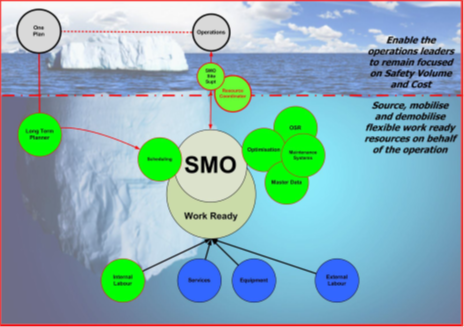
Choose a practical shutdown pathway
Strengthen shutdown readiness
Use the case studies to improve scope freeze discipline, workfront readiness, logistics planning, contractor alignment, and start-up and close-out control.
Lift governance and assurance
Use the IPR and review workshop models to establish independent readiness checks, action closure discipline, and repeatable shutdown stage-gates.
Improve execution discipline
Use the 360° and 6W1H models to connect labour, planning, inventory, cost, logistics, and field control into one integrated shutdown operating rhythm.
Build leadership capability
Use the leadership and turnaround case studies to reinforce visible leadership, accountability, safety discipline, and operational control at the workface.