What is DAM (Digital Asset Management) and Why do we need it?
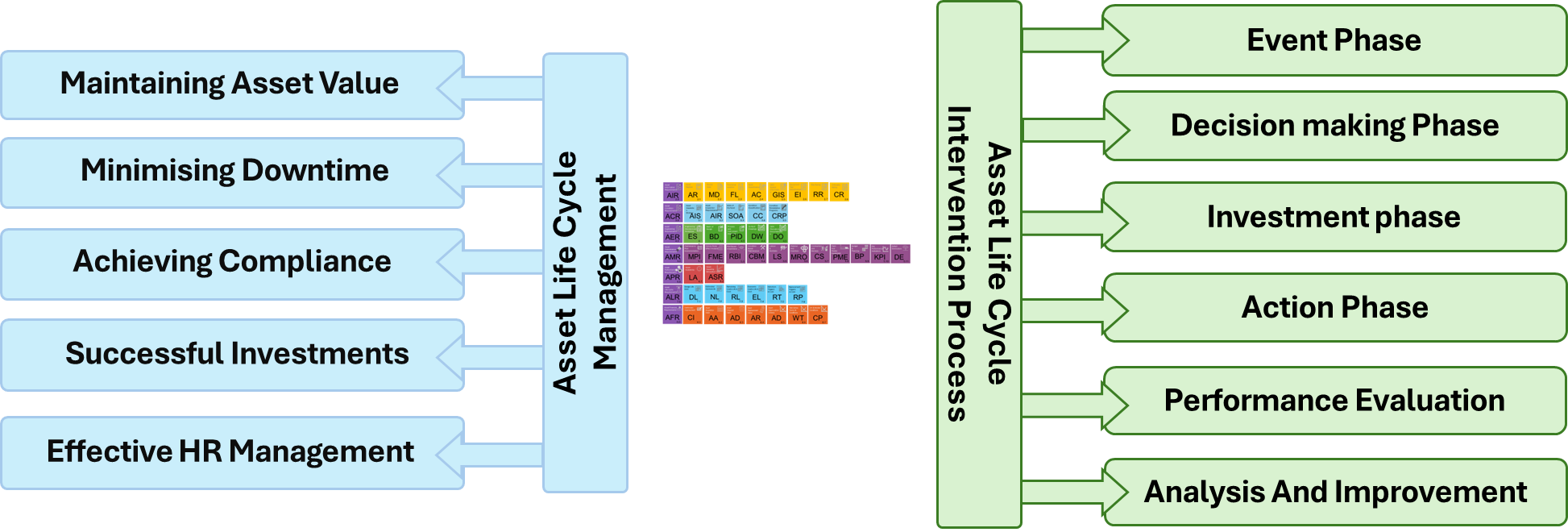
The AM8760 Digital Asset Management (DAM) elements are designed to guide organisations in effectively managing their physical, informational, and operational assets through a structured, life-cycle-centric methodology. It places emphasis on asset information integrity, condition monitoring, maintenance planning, engineering requirements, performance optimisation, life-cycle considerations, and financial stewardship—all underpinned by continuous improvement principles.
AM8760 Digital Asset Management harnesses modern digital technologies to support comprehensive asset stewardship. By integrating condition monitoring, predictive analytics, and digital twins, it enhances the preservation of asset value across the lifecycle.
Asset deterioration or data inconsistencies often trigger event phases where asset managers must assess impact and decide on interventions. Investments are then allocated to improve digital capabilities or asset condition monitoring, followed by coordinated actions to implement improvements. Performance is continuously evaluated to ensure system effectiveness, with ongoing refinements enhancing the digital management framework.
This integrated approach supports organisational objectives by optimising the balance of cost, risk, and performance.
ISO 55000 & 55001: AM8760 DAM supports asset management policy deployment and strategy development in alignment with ISO 55001’s core principles of risk-based, life-cycle-focused asset management.
ISO 55002: The framework’s guidelines on processes, documentation, and governance closely follow ISO 55002’s recommendations, ensuring systematic implementation of an asset management system.
ISO 55010, 55011, 55012, 55013: These complementary standards provide advanced guidance on integrating financial, operational, and strategic elements. AM8760 DAM adopts these best practices to foster cross-functional collaboration and continuous improvement.
GFMAM Asset Management Landscape Ed. 3: AM8760 reflects the GFMAM “7 Subjects” by aligning Strategy & Planning, Decision-Making, Life-Cycle Delivery, Asset Information, Organisation & People, and Risk & Review into an integrated management system.
Asset Information Requirements (AIR): Establishes the digital backbone by structuring and categorising data to ensure accuracy, accessibility, and usability. Clear asset information enables fault detection, reduces downtime, supports auditability, and drives consistent governance.
Asset Condition Requirements (ACR): Integrates risk-based inspections, condition monitoring, and defect elimination programs. Real-time insights enable early detection of degradation and trigger prioritised remediation or refurbishment actions.
Asset Engineering Requirements (AER): Ensures design principles, standards, and engineering documentation preserve asset integrity and compliance. Event-driven updates to engineering processes foster safer operations and reduce failures.
Asset Maintenance Requirements (AMR): Provides structured planning and execution of maintenance using methodologies such as FMEA, risk-based inspections, material management, and workforce capability planning.
Asset Performance Requirements (APR): Defines KPIs, targets, and improvement processes to uphold reliability and operational excellence. Performance declines trigger root cause analyses and corrective actions.
Asset Life-Cycle Requirements (ALR): Manages assets from acquisition to disposal, optimising value and ensuring alignment between design life, operational demand, and replacement strategies.
Asset Financial Requirements (AFR): Integrates depreciation models, replacement value analysis, budgeting, and warranty considerations to ensure financially sound asset decisions and sustainable investment planning.
Event handling provides a dynamic, structured method for responding to changes in asset condition, performance, or data quality. It reinforces disciplined decision-making and ensures asset management remains proactive and adaptive.
Recognition Phase: Detects anomalies, inconsistencies, or operational risks.
Decision Phase: Evaluates impact, asset criticality, and cost-risk-performance trade-offs.
Investment Phase: Allocates resources for remediation, technology upgrades, or capability building.
Action Phase: Executes interventions through coordinated teams and planned work.
Performance Phase: Monitors outcomes to verify effectiveness.
Improvement Phase: Embeds lessons learned into standards, processes, and systems.
Robust Governance: ISO 55000 principles embedded into organisational roles, responsibilities, and processes.
Risk-Based Decision-Making: Integration of criticality, inspections, and failure analysis ensures resources are prioritised where they matter most.
Life-Cycle Optimisation: Ensures total cost of ownership and asset value are continuously evaluated to support reinvestment decisions.
Enhanced Data Integrity: Centralised, well-structured data enables predictive analytics and improves decision confidence.
Continuous Improvement: GFMAM-aligned processes ensure organisations adapt to changing technologies, regulations, and operational contexts.
Enter the World of DAM to Learn More………